Friday, February 5, 2010

Weekly Wrap


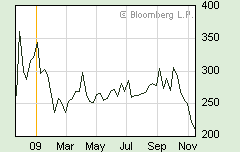
The number that spooked Wall Street yesterday was the figure released by the U.S. Labor Department showing initial claims for state unemployment benefits. The 480,000 reported was up from the week earlier and higher than the four-week moving average (plotted above). After a peak approaching 700K a year ago, job turnover has lessened considerably since. Still, as John Thomas (a.k.a. the Mad Hedge Fund Trader) points out, there is room for improvement:

Someone once asked PIMCO’s bond king, Bill Gross, if he were stranded on a desert island and could get only one statistic on which to base investment decisions, what would it be? He didn’t hesitate. Initial claims for unemployment insurance, released by the Labor Department every Thursday at 8:30 am EST, gives the best real time snapshot of economic activity... During the first half of 2009, more than 600,000 new claims a week were common. Since then, they have dropped to a still serious 450,000/week, indicating, at best, a tepid recovery. When claims drop below 400,000, the unemployment rate will stop rising, below 350,000 a recovery is in progress, and below 300,000 the boom times are back.

This "morning after" the mini-meltdown in the markets brought the monthly unemployment report from the Bureau of Labor Statistics, and investors are having a hard time grappling with the data. The report gave mixed signals as to whether jobs were added or lost in January. The Establishment Survey says we lost 20K. The Population Survey says we gained 785K, a number that, if believed, should be igniting a rally in stocks. But the report cautions that, effective January 2010, the latter survey uses "updated population estimates" and may be overstating the job gain by 243K. The apples-to-oranges comparison is apparently confusing not just me. As of 10:55 a.m. the Dow is unchanged.

Nobody is talking about the Adjusted Household Survey number, a series that attempts to reconcile the CES and CPS numbers. That one is +841K! Maybe we should take these preliminary numbers with a wheelbarrow of salt; they will just get revised again (and again) anyway. For example, December's CES figure got changed from -85K to -150K. An annual benchmark revision moved up the job-loss figure for all of 2009 another 617K, bringing the two-year recession total to 8.4 million. As Benjamin Disraeli once said, there are three kinds of untruths: lies, damn lies, and statistics.

Channeling Disraeli, Mike Mish Shedlock points out that the BLS massages the unemployment data even more than usual in the month of January. And he has a graph to prove it:

[click to enlarge]

The rest of every year is spent reverting to the mean. All this suggests that the 9.7% unemployment rate reported for January is a myth and that we could easily see 11% by summer. TrimTabs, working backwards from tax-collection data, calculates that the number of jobs lost in January likely exceeded 100K, or five times more than the "official" number.

On the bright side, the average work week inched up in January another six minutes, which, believe it or not, is the wage equivalent of tens of thousands of jobs. State governments, obliged to balance their budgets, cut 41,000 jobs last month. The federal government, under no such budget constraint (more on that below), added 33,000 jobs. You can thank our creditors (China et al.) for those. All in all, the BLS report was a wash. But whatever the real job numbers are, they need to improve dramatically, and soon. Adjustable-rate mortgages across the land are ready to explode. Disarming them will require millions of new jobs, not thousands.

President Obama's FY2011 budget was greeted with angst when it was rolled out to the press on Monday. You got the heads-up here last Friday that the headline number on the expenditure side was going to tickle $4 trillion, 40% to be funded by new debt. I'll say it again--four trillion dollars. Hopefully by now I have trained you to look for the REAL number.

Before we can find that one, we must review how the federal government keeps its books. Unlike all the banks it regulates, it uses the cash method of accounting, tracking only current expenditures. The Citigroups, the JPMorgans--all those financial institutions that we love to hate--use the accrual method. They attempt to project costs beyond the present and will reserve some of their earnings to meet those future liabilities. The global financial crisis that has been brewing since the summer of 2007 can be blamed on the failure of the banks to reserve enough for the future in light of the high degree of risk that they were undertaking with subprime and subslime lending.

Federal regulators are now (a bit late, I would say) tightening up on the banks, raising capital requirements. But who is overseeing the federal government, which has been piling up liabilities within its entitlement programs (primarily Medicare and Social Security)? It is supposed to be holding monies in trust for future pay-outs, monies paid into the system by employers and employees under one of the government's original mandates. But since the days of hey-hey-LBJ, the government has been raiding the trust accounts to fund current operations, creating future liabilities without tracking them in annual budget statements. If we were properly reserving for future pay-outs, we would be showing much higher deficits.

On Christmas Eve, Treasury Secretary Timothy Geithner gifted taxpayers with the announcement that the federal government would backstop all home mortgages held by GSEs Fannie Mae and Freddie Mac. Presto! Trillions in new liabilities added to our collective balance sheet, all without congressional approval. Which brings us back to the question, what is the real annual federal deficit? Answer: no one knows. But the number must come from a certified public accountant (any of those in DC, or are they all attorneys?) and is assuredly some multiple of the $1.556 trillion that the Big O is proposing for 2011. The Government Accountability Office, which audits the books, will not even hazard a guess, offering this disclaimer:

Because of the federal government's inability to demonstrate the reliability of significant portions of the U.S. government's accompanying accrual basis consolidated financial statements for fiscal years 2008 and 2007, principally resulting from certain material weaknesses, and other limitations on the scope of our work, described in this report, we are unable to, and we do not, express an opinion on such accrual basis consolidated financial statements.

"No opinion" means the numbers are worthless. As the debt rolls forward to our children and grandchildren, I will whisper in their ears the magic words. Strategic default. That's right, it's time to repudiate the national debt. It is not morally defensible for one generation to sell another one (or more) into slavery. And what would I say to the creditors, the ones holding all those Treasuries? Tough noogies. You took on the risk, you suffer the consequences. In the Mother of All Workouts, you bondholders, as always, will have to take a haircut.

There, glad I solved that one.

[update, 02-08-10: In this Bloomberg interview, Marc Faber calls U.S. debt "junk."]

[Niall Ferguson in a
Financial Times column, 02-11-10:

US government debt is a safe haven the way Pearl Harbor was a safe haven in 1941. Even according to the White House’s new budget projections, the gross federal debt in public hands will exceed 100 per cent of GDP in just two years’ time. This year, like last year, the federal deficit will be around 10 per cent of GDP. The long-run projections of the Congressional Budget Office suggest that the US will never again run a balanced budget. That’s right, never.]


Monday, February 1, 2010

Friday, January 29, 2010

Weekly Wrap


Sounding like he really means it, President Barack Obama promised earlier this week to rein in spending by the federal government. His proposed three-year budget freeze, however, does not apply to military intervention overseas, to homeland security, to entitlements, nor to economic-stimulus-that-may-be-needed-from-time-to-time. That leaves only one-sixth of the budget to be "frozen." For everything else, the sky's the limit.

Déjà vu all over again, as Yogi would say. This freeze in "discretionary" spending is exactly what Obama's predecessor, George W. Bush, proposed two years ago when rolling out the nation's first $3 trillion budget. And how well did that work? Glad you asked. The FY2009 budget started ballooning before the ink was dry when Bush okayed the TARP bailout. With the banks taken care of, Obama allocated unspent TARP money to the auto industry. Then came the $787 billion stimulus package. When the fiscal year came mercifully to a close last September 30, federal spending for the year finished just shy of $4 trillion.

Trouble was, $1.8 trillion of that had to be borrowed. $383 billion of it was interest paid on money already borrowed. Obama's "freeze" will not stop the red ink. His FY2011 budget calls for spending $3.6 trillion, or 16% more than the last time a U.S. President used the word "freeze." Can you imagine what a thaw would look like? Congress already has. Yesterday the Senate voted to raise the nation's debt limit by $1.9 trillion to $14.3 trillion. Plus ça change. Now if only the French had a word for entrepreneur.

Add public and private debt together, and you get a number approaching $50 trillion, or almost four times GDP, a record in the U.S.:


The graph illustrates that the debt-to-GDP ratio last saw a similar peak in midst of the Great Depression. It also suggests that much of peak debt needs to be extinguished before sustained economic growth can resume. As Van Hoisington and Dr. Lacy Hunt explain, "once debt becomes excessive, countries do not grow their way out of the problem; they must go through the time consuming and often painful processes of debt repayment and increased saving."

But growing our way out of the problem is exactly what the Obama Administration is trying to do--with fiscal stimulus and near-zero interest rates. The goal: creating more debt in an economy already swamped by debt. Over-exposed consumers are doing the right thing by paying down credit balances, but lenders are too slow to write off bad debt, some of which has simply been transferred to the Federal Reserve Bank's balance sheet through the creation of new fiat currency. American exceptionalists, take note. A recent book written by Carmen Reinhart and Kenneth Rogoff entitled This Time Is Different concludes, after abundant historical research, that no time is ever different: debt deflations are always painful and protracted.

Just in from the Commerce Department:
GDP grew at an annual rate of 5.7% in the fourth quarter of 2009. Before jumping to the conclusion that we can grow out of this mess, look more closely. Most of the statistical increase was due to the restocking of depleted inventories; final sales were up a more modest 2.2%. Personal consumption was up just 1.4%. Hours worked in the private sector were down 0.5%. David Rosenberg of Gluskin Sheff calls it the Houdini recovery, destined to disappear once inventory builds and capital spending have run their course. Bottom line, today's headline GDP is a rear-view, drug-induced number unlikely to be repeated anytime in 2010.

Wednesday, January 27, 2010


Who's the mark? Revealed here.


Monday, January 25, 2010

Friday, January 22, 2010

Weekly Wrap

We know he drives a truck--but what kind? Is it one of those monster-ma-deals seen at car shows, the ones that drive up and over a whole row of puny imports, crushing them in the process?

Whatever it is, the Wrentham Wrecker (owner: Scott Brown, Republican) has been leaving tread marks all over the political landscape. The first to be flattened was Martha Coakley, Massachusetts AG and Brown's opponent in the race for Ted Kennedy's U.S. Senate seat. In Tuesday's election, Brown won going away. Add to the road kill President Barack Obama's health reform bill, which succumbs to the new math in the Senate.

Want more victims? How about Treasury Secretary Tim Geithner? Check out where he is standing in the photo below, taken at a press conference yesterday:


Turbo Tim is at the far left, displaced in Obama's inner circle by former Fed Head Paul Volcker (the six-foot-seven legend looming large behind the President). Geithner has been coddling the big banks on Wall Street throughout the financial crisis, while Volcker has been urging the President to cut them down to size. Brown's victory has improved Obama's hearing, thus Thursday's rollout of the new Volcker Rule.

Geithner does not get a rule named after him. Instead, he gets to go stand in the corner. Look at the photo again. How bad is that when your boss uses MA Congressman Barney Frank as a physical buffer between you and him? O.K., O.K., maybe Obama was just trying to win back some favor with Bay Staters by showcasing their congressman. Still, Tim does not look happy. He has since leaked his displeasure with the bank bashing, which means that his days on the job may be numbered.

Another heavyweight in line for a pink slip is none other than the current Federal Reserve Chair, Ben Bernanke, who needs to be confirmed by the Senate before the end of next week to be assured of another term. Today Senators are falling over one another reaching for the microphone to announce to their constituents that they will not support Bernanke's nomination. Credit Brown for this rush to the exits, as well as for Obama's instant lame-duckery. (How's this for lame: Obama jumped on Brown's bandwagon, I mean truck, by claiming in a morning-after interview that he was the original Scott Brown in 2008, before Scott Brown even thought about being Scott Brown.) Amazing; Obama went from the hunter to the hunted in just one year.

Anyone get the plate number on that truck?

[update 01-28-10:]


The Senate votes on Bernanke's nomination...


Monday, January 18, 2010

Friday, January 15, 2010

Weekly Wrap

A "tell" for Election Year 2010? That is how pundits describe next Tuesday's special election in Massachusetts for the U.S. Senate seat formerly held by the late Ted Kennedy. In a normal year, a seasoned Democratic public servant like Martha Coakley (above) would coast to victory in the liberal Bay State. But recent polls are all over the place as to how close this race really is. Republicans are trumpeting that little-known state senator Scott Brown (below) has pulled into a dead heat. Can this be for real?


This race may be an early referendum on President Barack Obama's ambitious healthcare reform bill, still being worked out in Congress. The President had hoped to have the legislation passed by Christmas and now wants it no later than his State of the Union address (date still uncertain, possibly in early February). The real deadline may be January 28, the day before the Massachusetts Secretary of State certifies the results of the special election. If Brown wins, he becomes the 41st Republican Senator, the marginal vote that a unified Republican caucus needs to filibuster the healthcare bill. It's a race within the race.

Coakley probably wishes that Congress had met the original target date. That would have gotten her off the hook for a bill that most Americans oppose but which she supports. Brown has pounded her on this issue, which distracts voters from the good work that she has done as the state's attorney general. She investigated contractor abuses arising from Boston's infamous Big Dig and two years ago was busy chasing down miscreants on Wall Street for peddling toxic derivatives to citizens and cities alike (documented here and here). As well, she questions the surge in Afghanistan, a stance that should earn her brownie points in the only state won by anti-war candidate George McGovern in the 1972 Presidential election.

If Coakley loses, or even wins with less than a 50% majority, it will be because of her party affiliation--and her party's damn-the-torpedoes commitment to bigger government. As David Rosenberg of Gluskin Sheff offers in this morning's "Breakfast with Dave," the outcome in Massachusetts may betray "the general public's concern over the implications of running up a fiscal tab that could threaten the country's future prosperity to curb today's consumer deleveraging pain--a mini Tea Party of sorts, which is why the vote is being held in the right state."

Don't forget the banks. No way can I wrap the week without a quick look at the financial sector. Reporting this morning, JPMorgan Chase was the first of the big banks out with fourth-quarter earnings. The lipstick was good (profits quadrupled from the preceding quarter), but the underlying complexion was spotty. Revenues came in a bit light; and loan-loss provisions for two divisions, Retail Financial Services and Card Services, added up to $8.5 billion. Firmwide credit reserves now total $32.5 billion and, according to management, may expand further in 2010, meaning charge-offs for bad loans are far from over. "Consumer credit costs remain high and weak employment and home prices persist,” said CEO Jamie Dimon. “Accordingly, we remain cautious.”

How cautious? The company left its quarterly dividend at a nickel a share, where it has been for the past year (after getting axed from 38 cents last February). Investors are disappointed, knocking a buck off the share price in today's trading. And this is one of the strongest banks out there. What happens when ne'er-do-wells Citigroup and Bank of America, more highly leveraged to struggling consumers, report next week? The mind boggles. Maybe that's why the Dow is down triple digits today. Black Tuesday, anyone?

But Diamond Jamie has his. Even as the company was flipping nickels to shareholders, the average compensation for each JPMorgan employee jumped 20% in 2009. Doesn't that make you feel good all over?

Wednesday, January 13, 2010

Job-Less Recovery

The chart above has been widely shared by bloggers in the past week. It shows negligible job growth in the U.S. over the past decade. Jobs created by the debt boom of the first part of the decade have been repealed in just the last two years.

Next question: when are they coming back? Optimists are banking on a V-shaped recovery any day now. Typically job growth resumes within a month or two after the economy hits bottom, but research at Hussman Funds finds that the current recovery is hardly typical. If we assume that growth in GDP reported for the third quarter of 2009 marked a bottom at the end of June, then the current employment trend (illustrated by the red line below) is clearly lagging the average bounce (in blue):


In fact it more closely resembles the delayed recovery following the 2000-01 recession:


...all of which suggests that we might have another two years or more of flat to negative job growth.

Except for public-sector jobs. While private-sector nonfarm payrolls have declined by 6.625 million (-5.8%) since January 2007, total government jobs have increased by 355,000 (+1.6%). Taxes on the former (goose) pay for the latter (golden eggs), so one wonders how long that disparity can continue. Expect it to widen in 2010 as we go about the decennial task of counting ourselves.

Chris Wood at Casey Research summarizes: "the loss of employment has occurred entirely in the private sector, as Uncle Sam grows more bloated each day. If you happen to be in the private sector, it also might not psych you up too much to know that the average pay per federal worker in 2009 was reportedly $75,419, while per capita average annual income across the U.S. is only about $36,000."


Monday, January 11, 2010

Friday, January 8, 2010

Weekly Wrap


1.4 million Americans filed for bankruptcy in 2009,
one-third more than the year before, according to a report earlier this week in the Wall Street Journal. Recall that President George W. Bush tried to suppress bankruptcy filings by signing the Bankruptcy Reform Act of 2005. At first it was mission accomplished. Following a rush to the exits by filers hoping to beat the new law, bankruptcies dropped by three-fourths in 2006. As the chart above shows, they have been rising ever since.

Running for re-election in 2004, Bush championed the concept of the "ownership society," proclaiming that "America is a stronger country every single time a family moves into a home of their own." Of course, for most folks owning a home means taking out a mortgage. The Bush Administration, aide and abetted by Congress, facilitated widespread "ownership" by allowing exotic mortgages with no down payments, little or no payments for the first few years, and no documentation of a borrower's ability to repay. In truth, most of the owning going on during Bush's second term was banks (and upstream investors) coming to own uninformed borrowers.

With the Bankruptcy Reform Act, Bush and his acolytes in the banking industry wanted to make sure that borrowers would forever own up to their debt, not slough it off when times got tough. It should have been called the Debt Slave Act, says Mike Mish Shedlock, who considers it poetic justice that a bill designed to promote high-risk lending has backfired. Shedlock is not at all surprised by the uptick in bankruptcies, particularly Chapter 7 filings, which clear the deck by liquidating assets to pay off some debts and absolving filers of the rest. "If you're unemployed, struggling, and deep in debt, it may be best to get it over with." And do it now, before you're re-hired, while the means-testing for Chapter 7 works in your favor.

In cases where borrowers cannot simply walk away from their debt (as they do when, for example, defaulting on no-recourse home mortgages), they are smartly paying down high-interest loans. The American Banking Association reported yesterday that delinquencies declined in the third quarter for most types of consumer loans, including auto loans and bank cards. The exception: housing-related loans. Home-equity-loan delinquencies rose to a record 4.30% of all accounts, and mobile-home delinquencies were up as well, to 3.63%. This may be a sign that homeowners feel entitled to forbearance on housing-related debt. They also sense that banks are in no hurry to foreclose on residential properties in a saturated market.

Today the Federal Reserve reported that total seasonally adjusted consumer debt (all debt not secured by real estate) fell $17.5 billion in November to $2.46 trillion. Annualized, that is a drop of 8.5%, almost twice the cumulative rate of decline since consumer credit peaked at $2.58 trillion in Q3 2008.

Another thing that consumers are walking away from is their health insurance. Today brings the news that Anthem Blue Cross and Blue Shield, the largest health insurer in Maine, is seeking a rate increase of 23% for its 11,000-plus individual policy holders. If approved, the bump would cap a decade of truly mind-boggling increases in health premiums. Despite the increases, Anthem is losing money on individual policies as healthy subscribers migrate elsewhere (my wife and I dropped our HealthChoice years ago). Those left are experiencing the classic "death spiral."

I have my own plan for healthcare reform, and it doesn't take up 2,000 pages like all those congressional plans do. It takes up just one. The keystone is saying good-bye to private health insurers, not subsidizing them they way congressional Democrats propose to do. Incidentally, the reform proposals now in the pipeline are impeding economic recovery, as Kristin Graham ably explains.

So what's driving all those bankruptcies and delinquencies? Other than the high costs of healthcare, that is. Why, it's the weak labor market, of course. Four million jobs in the U.S. were lost in 2008, another four million in 2009. We needed to add 2.5 million jobs during those two years just to keep the unemployment rate from rising. This morning there was the widely anticipated report from the Bureau of Labor Statistics on the employment situation during the month of December. Prior to the news release, there had been hope that, for the first time since December 2007, the U.S. economy might have added jobs (the "whisper" number was +100K).

Alas, another 85,000 jobs were lost--or more, depending on what number you use. The Establishment Survey figure of -85K was the least damaging. The Household Survey yielded a whopping -589K. The number to which I pay the most attention--the adjusted household survey--came in at -465K. Folks, those numbers are just plain awful. As I write, stock traders seem to be reaching for their Tums. No surprise; they were warned.

Jake at EconomPic has graciously updated his chart showing hours worked per week per capita. Sobering.

Big deal. Who needs to work for a living these days? The government has you covered. Personal Current Transfer Receipts, as defined by the Bureau of Economic Analysis, are "benefits received by persons for which no current services are performed" (e.g. retirement and disability insurance benefits, worker's compensation, medical benefits, unemployment insurance and other income assistance, etc.). Transfer payments now add up to one-fifth of GDP. That's groovy. But, as former British Prime Minister Margaret Thatcher pointed out, "the trouble with socialism is that you eventually run out of other people's money."


Up, up, and away...


Monday, January 4, 2010

Wednesday, December 30, 2009

Year-End Wrap

I think we go into the Japan scenario.
I think there's no escaping.

[A lost decade.]

Right.

--Charles Nenner,
interviewed by John Thomas, 12-10-2009
(Hedge Fund Radio)


Cycle analyst Charles Nenner (see website) predicts that stocks and bonds will sell off beginning the second week of January, leading to a painful double-digit correction. Longer term, he sees a low- to no-growth economy for the next decade, a baked-in consequence of the debt bubble created during the past two decades.

It would be a mistake to think that all that bad debt has disappeared. Some has made it onto the Federal Reserve's balance sheet (see the powder-blue slice in the graph below). As James Turk explains in his Free Gold Money Report, for the past year the Fed has been buying toxic debt that nobody else wants--with "money" that did not even exist a year ago:


The Federal Reserve now owns over $1 trillion of mortgage-backed securities...[and has become] very highly leveraged, much more than most banks. It is carrying $2,157.0 billion of debt on $52.8 billion of capital, giving it a leverage of 40.8-times more debt than capital. The mortgage-backed securities it owns are 19-times greater than the Federal Reserve’s capital, meaning that if the true value of these assets is 5.3% less than their book value, the Federal Reserve’s capital is depleted, effectively making it another insolvent institution...It remains liquid because banks continue to provide it with funding and because people continue to accept in commerce and use without question the Federal Reserve’s liabilities, i.e., the paper currency it issues. But for how much longer? (www.fgmr.com)

In addition to the $1 trillion in MBS purchased outright, there may be hundreds of billions more (a public audit would tell us for sure) offered as collateral for the loans pictured in green. This toxic brew is a ticking time bomb.

Happy New Year, indeed.

Monday, December 28, 2009

Wednesday, December 23, 2009

Weekly Wrap


This work week is abbreviated, and so was the "recovery." This morning brought a double dose of bad news for the housing industry, which is being counted on to lead the U.S. out of recession. First, the Mortgage Bankers Association Purchase Index (above), tracking mortgage applications for planned home purchases, made a U-turn south last week, declining over 11% from the week before, seasonally adjusted. The raw index was down almost 33% from the same week last year.

Then came a report from the Commerce Department that annualized sales of new homes in November declined over 11% (to 355,000) from the month before--even after October's figure was revised downward from 430K to 400K (the five months ending in October were running at 404K). The back-to-back announcements of double-digit drops from already depressed bases brought a screeching halt (at least for now) to this week's rapid rise in bond yields. Such a rise generally signals a pick-up in economic activity.

GDP growth in the third quarter was revised downward again, to 2.2% (after an earlier revision from the initially reported 3.5% to 2.8%). It has been estimated that the now- defunct Cash for Clunkers program added 1.5% to Q3 GDP, and a replenishing of inventories accounted for the remaining growth. Otherwise, GDP was flat. Again, from a depressed precursor. Despite massive government stimulus. Take that to the bank, why don't you.

Intent on further crippling the economy, President Obama continued his full-court press on Capitol Hill for healthcare reform. Needing two votes to invoke cloture in the Senate, the prez larded the bill with the "Cornhusker Kickback" and the "Louisiana Purchase," exempting Nebraska and Louisiana from any cost-sharing for future Medicaid expansions. The other 48 states can go [abuse] themselves. It is just this kind of horse-[trading] that gets me thinking about secession.

In last week's pep talk at the White House, the Big O told Senate Democrats that they were "on the precipice" of an historic accomplishment. The President is known for his careful choice of words:

prec·i·pice
n.
1. An overhanging or extremely steep mass of rock, such as a crag or the face of a cliff.
2. The brink of a dangerous or disastrous situation: on the precipice of defeat.

Tomorrow at 7 a.m. the Senate will most likely pass its version of healthcare reform, taking us all one step closer to the edge.

Jobs will be hard to come by, with or without healthcare legislation. Late yesterday Cintas Corporation, the largest U.S. supplier of work uniforms, reported disappointing quarterly earnings. Today investors dumped the company's stock, sending the share price down by more than 11%. (What is it with this number eleven?) Clearly the company's fortunes are tied to job creation. When asked to provide guidance for upcoming quarters, CFO Bill Gale gave none, saying only that "we believe the current analysts' estimates are overly optimistic for the remainder of this fiscal year and into 2011." Get that? Two thousand eleven.

In other words, investors betting too soon on a recovery will lose their shirts.

Monday, December 21, 2009

History Harmonizes

[click to enlarge]

"History does not repeat itself, but it does rhyme."

--Mark Twain


Monday Muse


Linda Ronstadt

Blue Bayou


Friday, December 18, 2009

Weekly Wrap


The charade is over.
Citigroup's busted stock offering late Wednesday has exposed the banking industry's game of "extend and pretend." Flash back to last March, when investors recognized that Citi and many other banks were hopelessly undercapitalized for a coming tsunami of loan defaults in commercial and residential real estate and in consumer credit-card debt. Citi was trading at a buck, Bank of America at three. Wells Fargo traded briefly at a hat size, and the two Morgans, Stanley and Chase, were teenagers.

Then ensued a seven-month rally that saw these stocks triple, quadruple, even quintuple. The rally was aided and abetted by the U.S. Treasury Department, which first injected tens of billions of TARP dollars directly into the banks, then certified their health with feeble "stress" tests. The Federal Reserve helped by bidding for toxic assets, taking some off the banks' balance sheets and enabling an artificial mark-up of what remained. Smitten investors bought the lipstick. New share offerings were snapped up as investment banks bulled (and underwrote) each other's stock. For two quarters, losses turned to profits, thanks largely to inflated asset prices. The government's pump-and-dump scheme seemed to be working.

Treasury actually got cocky. Earlier this month Treasury Secretary Timothy Geithner blithely announced that almost all of the $370 billion jettisoned by TARP in last year's bail-out frenzy would be recovered. Then the Department reached for $90 billion of it just in the past week, allowing Bank of America, Citigroup, and Wells Fargo to repay government loans. Mission accomplished? Not yet, according to bank regulators, who remain unconvinced that the Three Amigos (particularly Citi) are ready for prime time on their own.

Which may be precisely the point. With a flood of foreclosures coming after the new year, Geithner must have realized that zombie investors will soon wake up, closing the window for new capital raises. He therefore fired his starting pistol, and the race to the window was on. Bank of America got there first, followed quickly by Wells Fargo. By the time Citi got there, the window, while not completely shut, was on the way down. Citi had to discount its shares by 20% to clear the merchandise.

Citi's $20.5 billion offering is the largest in U.S. history. There are now enough Citi shares in circulation to allocate four to every human soul now walking the planet. To placate regulators, Treasury had stipulated that Citi repay the TARP loan entirely with fresh capital--in sharp contrast to BofA and Wells Fargo, required to raise only half of their TARP refunds. Treasury still owns an equity stake in Citi and was hoping to ditch some of it on the heels of the offering, but postponed those plans when the new share price put its investment--our investment as taxpayers--underwater. My expectation is that Citi's stock price retreats from here, that we'll be so far underwater in the next six months that we'll be feeling the bends.

The Federal Deposit Insurance Corporation's budget for 2010 was approved by its board earlier this week, expanding from $2.6 billion in 2009 to $4 billion. Why the 54% jump? Simple. Bank failures will accelerate in the coming year because of the above-mentioned tsunami of loan defaults. The FDIC's job is to clean up the mess, transferring assets to healthy banks and making depositors whole.

The FDIC is an independent agency, funded not by Congress, but by premiums paid by banks and thrift institutions for deposit insurance coverage. Established during the First Great Depression, it is not part of the federal budget process and has its own fiscal year. The agency expects to boost its staff by 1,600 (23%) to handle the coming workload. Its job is to protect $4 trillion (with a "T") of deposits, and right now its Deposit Insurance Fund stands at--could this be?--negative $18.6 billion.

That's the new balance after seven more banks folded late today, bringing the total for 2009 to 140 (with an overall hit to the DIF of over $30 billion). As these magnificent seven were deep-sixed, a new concern arose: there may not be enough healthy banks left to take over the casualties. For two failed banks in Michigan and Illinois, temporary "bridge" banks were set up to handle customer accounts. The affected Michigan depositors will have 45 days to get their money out before the temp closes. Depositors at a failed Georgia bank will simply be mailed checks.

The new mantra for orphaned clients of a damaged industry: What's in your mattress?


Wednesday, December 16, 2009

Fat Cats Put on Diet


Riddle: How do you get an insolvent company to pay back the money it owes you? Answer: Threaten to cut the CEO's pay.

That's what "special master" Kenneth Feinberg (a.k.a. the Pay Czar) is doing. Appointed by the President, Feinberg is reviewing the executive compensation paid by firms receiving "exceptional assistance" last year from the Troubled Asset Relief Program, or TARP. He wields the kind of power that Huey Long-ed for 75 years ago.

Quick history lesson. Huey Long (pictured above) was a fiery populist from Louisiana who managed to serve as governor and U.S. Senator simultaneously. How's that for clout! He had such a stranglehold on state politics that he became known as The Kingfish. His popularity with the voters arose from his conviction that wealth in the U.S. should be distributed more evenly. He wrote a book titled Every Man a King and promoted a "Share Our Wealth" plan, calling for a guaranteed personal income of $2,000 and a maximum allowable income of $1 million. Anything over that would be subject to a 100% tax rate. An individual's accumulated wealth would also be taxed--at a rate of 0% for the first million, rising geometrically until it reached 100% for anything over $8 million. For the mathematically challenged, 100% is spelled C-O-N-F-I-S-C-A-T-I-O-N. (Multiply dollar threshholds by 15 to get today's inflation-adjusted equivalents.)

In 1935 Long was positioning for a third-party run for President, but then got himself shot to death in the state capitol building in Baton Rouge. By a doctor. Administering what they call high-velocity trans-abdominal lead therapy. Actually, there was no forensic examination to determine conclusively that Long was killed by his assailant, and not accidentally by one of his bodyguards, of whom he had many. Anyway, Huey was way larger than life. An estimated 100,000 mourners filed past his open casket in the state capitol rotunda.

But I digress. Today Ken-fish gets to finish what The Kingfish yearned to start: a whittling down of Wall Street salaries. In Round One, Feinberg went after the 25 most highly paid executives at each target firm. The cuts, announced in October, average 50% for total compensation (salary, stock, and benefits) and 90% for cash compensation. This week brings the bad news for second-tier executives, numbers 26 through 100, who are capped at $500,000 annually (no more than 45% to be paid in cash). Feinberg apparently can exercise some discretion. Exemptions may be granted for the most deserving, and the least deserving (think AIG) get hammered down further to $200K.

Huey must be salivating in his grave.

Sean Penn as Gov. Willie Stark in All The King's Men

Monday, December 14, 2009

Friday, December 11, 2009

Weekly Wrap


The Incredible Shrinking Paycheck
. Last week's announcement by Bank of America that it would pay back $45 billion in TARP money doled out by the feds a year ago was a desperate move to clear a salary cap imposed by pay czar Kenneth Feinberg. The cap was crimping the company's ability to hire a suitable replacement for outgoing CEO Ken Lewis. To stay competitive, Citigroup said this week that it would follow suit, returning $20 billion to TARP (another $25 billion had been converted to common stock, which the government plans to sell "in an orderly fashion" in 2010). So are bank execs home free? Not quite. Under pressure from shareholders, Government Sachs...sorry, Goldman Sachs (the first bank to exit TARP) revealed yesterday that its top managers would not be receiving cash bonuses this year, but rain checks instead, in the form of "shares at risk" that cannot be sold for five years and may be revoked for poor performance.

Speaking of TARP, Treasury Secretary Timothy Geithner said yesterday that the program would cost taxpayers $200 billion less than earlier projected, thanks to the paybacks of principal, dividends on outstanding investments, and proceeds from the sale of warrants (JP Morgan Chase warrants held by the government were just auctioned off for nearly $1 billion). Still, the program may not break even, as tens of billions allocated to AIG, GM, and Chrysler will not be coming back. Moreover, the TARP kitty is now treated by the Obama Administration as a revolving slush fund for additional economic stimulus. In other words, money successfully recovered will be put back at risk until it gets vaporized, all to buy your vote.

What should the TARP balance be used for? How about, as bank analyst Richard Suttmeier suggests, for rebuilding the Deposit Insurance Fund, which has gone negative in the last month? Every time the FDIC closes a bank, the DIF takes a hit. FDIC Chair Sheila Bair wants prepayment of three years' worth of premiums from insured banks to put the DIF back in the black. But with hundreds more banks likely to fail in the next 12-18 months (including three announced tonight), that won't be enough. An unfortunate consequence of the ongoing credit crunch is the subordination of depositors to derivative counterparties whenever a bank must liquidate. Of all people, savers should be made whole. They're already getting punished enough with dollar devaluation. Why should they have to stand in line behind zombie investors?

Maine revenues may be stabilizing. Yesterday the Legislature's Appropriations Committee received a report that General Fund revenues came in slightly over budget in November, a welcome contrast to the first four months of the fiscal year, when revenues were 8.3% under budget and down 9.3% year-over-year. Of course, one month does not a trend make. Furthermore, it was exactly one year ago when the state's revenues went into cliff-drop mode, so merely matching year-ago revenues going forward will be no big accomplishment. Certainly not a victory, but maybe we can stop retreating.

Still out of control on the expenditure side. Maine's very own public option, Dirigo Health, continues to bleed cash, so much so that it has had to borrow $25 million from other state accounts to maintain service to 8,636 Dirigo Choice subscribers (new applicants not wanted). Yesterday members of the Appropriations Committee asked when the $25 million would be repaid. "Search me," said Dirigo's executive director, Karynlee Harrington. Wrong answer, said an exasperated Bill Diamond, Committee Chair. "All the projected good news never seems to materialize," complained Diamond, a Democrat no less who is no doubt embarrassed that his party has owned this one since way before it was broken.

Exercising damage control, the governor's office wrote up a clarifying statement for Ms. Harrington, who late today passed the cut-and-paste job on to the press. The cash advance, the Harried One now insists, will be repaid by the June 30 due date, and in her (boss's) view legislators need not treat the missing money as a new liability to be added to the state's growing shortfall. So what exactly is the reason for the cash crunch? "Members are not terminating" fast enough, said the director on Thursday. (Does that mean not dying fast enough?) "Lower attrition than forecasted," said today's statement. In other words, the lower the enrollment, the healthier the balance sheet. Some business plan. Logical next step: reduce the enrollment to zero (not by everyone dying, but by taking the money away). As Tarren Bragdon has said, Dirigo should be Diri-gone.


Monday, December 7, 2009

Monday Muse


Christine McVie of Fleetwood Mac

Warm Ways


Friday, December 4, 2009

Light At the End of the Tunnel?


Perhaps not an oncoming train after all. Employment figures released this morning by the Bureau of Labor Statistics have everyone excited. The U.S. economy shed only 11,000 jobs in November. One must go back to December 2007 to find a better number than that. Moreover, job losses for September and October were revised lower by 159,000. The average work-week rose from 33.0 to 33.2 hours last month, while the unemployment rate dropped from 10.2% to 10.0%. These are all good signs.

Caution is still warranted, however. David Rosenberg of Gluskin Sheff points out that the raw number (not seasonally adjusted) was 80,000 jobs lost, coming in a month when traditionally 300,000+ jobs are added (holiday hiring and all that). Private-sector jobs dipped by 18,000 last month (and 4.7 million year-over-year), more than offsetting a gain in government jobs of 7,000. Since the former ultimately pay for the latter, we can deduce that government borrowing (how sustainable is that?) mitigated the overall erosion. The adjusted household survey showed a bleaker number: 109,000 jobs lost. And remember, the true "break-even" number for employment is not zero, but roughly +100,000. The economy must add that many jobs monthly to accommodate the growing workforce. Any fewer reduce hours worked per capita and, presumably, our collective standard of living.

Bank of America to repay TARP loan. Yesterday's headline, at first glance, suggests that things in the financial sector are getting back to normal. Don't be fooled. Sure, taxpayers are getting their $45 billion back, plus interest, which is cool for them. But risk has not been eliminated, just transferred back to BofA creditors and shareholders. The latter face further dilution with a new $19.3 billion stock offering, which, if you do the math, is not enough to replace the cash going back to Uncle Sam. The reduced Tier I capital ratio is not comforting news to bondholders.

Let's face it, the company had to repay Uncle Sam in order to create some wiggle room for executive compensation. With the TARP overhang, BofA's Board was simply unable to hire a replacement for CEO Ken Lewis, who wants to leave at the end of this month. Remember, the Adminstration's pay czar docked Lewis his entire salary for 2009. Who wants to take a job sparring with regulators, bankrupt customers, antsy bondholders, and aggrieved shareholders--all represented by legions of lawyers--for no pay?

How about the FDIC's Q3 Banking Profile? Released last week, the report revealed that the number of "problem" banks rose by 136 in the third quarter to a 16-year high of 552, with total assets at risk rising by 15% to $345.9 billion. Additionally, 50 banks failed during the quarter and are no longer counted. Think about it. For every bank that failed, nearly four more were added to the "problem" list (kind of like that mythological serpent Hydra with the nine heads: cut one off, and two grow back). Today is Friday, so we'll get to see how many more heads roll.

[update, 8 p.m.--Six more banks bite the dust, three in Georgia, one each in Virginia, Ohio, and Illinois. That makes a total of 130 in 2009, with three weeks to go.]

Also reported by the FDIC was a 10.5% increase in noncurrent loans and leases (90 or more days past due) to $366.6 billion, or nearly 5% of all loans and leases--the highest noncurrent rate in the 26 years that insured institutions have reported. Data from other sources detail the tenuous state of the union:

One in 7: home mortgages that are 30 days past due or in foreclosure.

One in 3: home mortgages with negative equity.

One in 5: mall storefronts that are vacant.

One in 8: Americans receiving food stamps.

One in 6: workers who are unemployed or under-employed.

One in 5: Americans eligible for Medicaid.


Monday, November 30, 2009

Friday, November 20, 2009

Maine Still Losing Jobs

[click to enlarge]

BLS news release, 11-20-09:

another 1,400 Maine jobs lost in October...
a total of 29,400 since the cycle peak.

[For an eye-catching time-lapse graphic on the rise in unemployment nationwide, go here.]


Wednesday, November 18, 2009

Mortgage Apps Rolling Over

MBA Purchase Index hits a 12-year low.

Wednesday is "Hump Day" for a reason.
That's the day we get our weekly reminder from the Mortgage Bankers Association that, for more and more Americans, the prospect of home ownership is a hill too high to climb. Featured periodically in this column, the MBA's Market Composite Index tracks the volume of loan applications for both new mortgages and the refinancing of existing mortgages. That index was down 2.5% from the week earlier on a seasonally adjusted basis.

Almost three of every four loan applications are for refinancing, not surprising given today's low interest rates. If we look only at applications for newly acquired homes, the figures are a source of concern for those looking for a "bottom" in housing. The MBA's seasonally adjusted Purchase Index (charted above) declined for the sixth straight week and 4.7% from the week earlier, reaching a level not seen since November 1997. The weakness was confirmed by data released this morning by U.S. Commerce Department on new-home construction: building starts tailed off 10.6% in October. It would seem that low interest rates (the average rate on a 30-year fixed-rate loan fell to 4.83% last week) are not stimulating sales to the degree hoped for by government officials.

"Now that the Fed’s program [to buy housing debt] has been extended and the government has extended its [first-time homebuyer's tax credit], I would expect things to improve,” economist Christopher Low told Bloomberg News. “If you don’t see an improvement within the next couple of weeks, that would indicate a problem."

[update 11-19-09:]
Let's turn our attention away from new home loans and examine the ones already outstanding. Today the MBA's chief economist, Jay Brinkmann, reported that 14.41% of all home mortgages in the third quarter were either in foreclosure or at least one payment past due. That's one in seven. Four million mortgages were at least 90 days past due or in foreclosure. These figures point to a huge shadow inventory of houses waiting to hit the market. Perhaps that explains the lull in new purchases. Buyers are waiting for fire-sale prices!


Tuesday, November 17, 2009

Meltdown Countdown, Part Deux


Liu Mingkang, Chairman of the China Banking Regulatory Commission, November 15, 2009:

The continuous depreciation in the dollar, and the U.S. government’s indication, that in order to resume growth and maintain public confidence, it basically won’t raise interest rates for the coming 12 to 18 months, has led to massive dollar arbitrage speculation...[It has] seriously affected global asset prices, fueled speculation in stock and property markets, and created new, real and insurmount- able risks to the recovery of the global economy, especially emerging-market economies.


Thursday, November 12, 2009

Get Ready for the Second Wave

First the subprimes, now the option ARMs...


[John Hussman's weekly market comment, November 9, 2009:]

The problem is that these Option ARM and Alt-A structures were specifically designed as “teasers” – allowing loans to be made without documentation of creditworthiness, in return for post-reset interest terms that were generally higher than a documented lender would have paid... Similarly, Option ARM mortgages typically have very permissive payment schedules prior to the reset date, which have allowed homeowners to essentially live in these houses (at least temporarily) with fairly discretionary payments. The data suggest that most of these borrowers have allowed their mortgages to “negatively amortize,” allowing the loan balances to grow larger even as property values have depreciated. Once again, the resets on these are problematic for borrowers with questionable credit- worthiness, who bought the homes largely in anticipation of price appreciation. For these borrowers, the transition from discretionary payments to more demanding terms is unlikely to be smooth.


Tuesday, November 10, 2009

Investing in the Future? Not.


[analysis from Annaly Capital Management:]

Companies are not reinvesting at a fast enough pace to keep track with depreciation, i.e. they are getting smaller in the face of reduced sales. On bank balance sheets, we’re seeing loans falling as banks lend less (and companies demand less credit), but securities on the balance sheet are rising…the banks are playing the curve by buying up securities, not lending. Unless we see a serious resurgence in end demand, which would mean a serious resurgence in wages, employment and credit availability, you won’t see a GDP boost from capital expenditures...you may indeed see a pick-up in mergers and acquisitions, analogous to banks buying existing loans in the form of securities instead of making new loans.

Instead of investing in new projects and innovation, companies are cutting costs, buying each other, buying their own stock, or just hoarding cash...We cannot shrink ourselves to prosperity.

[update, headlines for November 12: General Electric sells its security business to United Technologies, 3Com sells itself to Hewlitt-Packard]


Monday, November 9, 2009

Twenty Years Ago Today...


...Checkpoint Charlie was opened, Nov. 9, 1989.
So began the dismantling of the 28-year-old Berlin Wall.

Boston Globe Photo Gallery

James Carroll: "the greatest date of our lifetimes"


Saturday, November 7, 2009

Rising From the Napalm

...where the green shoots are real.

The Mad Hedge Fund Trader gives a lesson in demographics:

http://madhedgefundtrader.com/November_6__2009.html


Friday, November 6, 2009

Pick-a-Stat


Gone: another 190,000 jobs. So says this morning's press release from the Bureau of Labor Statistics. This number--the one that gets all the headlines--is from the "establishment" survey (CES), and it is plenty bad. Worse, though, is the "population" survey (CPS) number, which comes in three times higher at -589K. BLS tries to reconcile the two figures with the so-called "adjusted household survey." That one falls somewhere in between: -402K.

Does any of these numbers spell "recovery?" I didn't think so.

And now (thanks to Jake at EconomPic) for the number that has governors across the land reaching for their medication: hours worked per week per capita, now at 19.3. This means more dependents in a shrinking economy less able to support them.


Monday, November 2, 2009

TARP Money Goes Up in Smoke


Congress thought it had a better idea. A year ago it allocated $700 billion to a new Troubled Assets Relief Program to prevent a run on some of the nation's biggest banks. The Treasury Department used a good chunk of the $700B to buy preferred shares in those banks (think Bank of America and Citigroup), as well as in insurers (AIG) and other lenders (CIT). Taxpayers were sweet-talked into believing that these were "investments." TARP, it was said, would actually become a profit center for the federal government, with quarterly dividends generating an annual return of 5%. Not bad with real interest rates below zero.

Trouble is, many of the investments are turning sour. Yesterday, while most of the nation was diverted by NFL action, CIT announced that it is seeking bankruptcy protection. The resulting reorganization, once approved by the courts, will mean a 30-percent haircut for bondholders and a virtual wipeout for stockholders. Not only do we taxpayers lose our direct "investment" in CIT of $2.33B (as reported by Bloomberg), but as partial owners of Bank of America we lose another $2.25B in the debt swap. Meanwhile, 33 banks missed their TARP payments in August, up from the 15 who missed their May payments. Think we'll ever see any of that money?

TARP is scheduled to expire at the end of next month, which, as the Wall Street Journal pointed out last week, would be none too soon. Treasury treats TARP as a revolving fund, which means that as money is returned, it gets redirected back out again. It will keep getting "invested" in ever riskier enterprises until it doesn't come back. Congress can lock up the remaining money by doing nothing. But given its propensity to subsidize losers like Cash for Clunkers and Cash for Bunkers, nothing dollarable (as John Muir used to say) is safe.

Friday, October 30, 2009

Bringing the Boys Home--In Boxes

[Reuters]

"Going back to Alexander the Great, no one has ever had success
fighting the locals in Afghanistan."


--David Verdi, Vice President of NBC News


Tuesday, October 27, 2009

quattrocelli plays Rumford


Muskie Auditorium, October 26, 2009

play Chitarri on StreamPad below

[more selections at quattrocelli's MySpace player here]


Monday, October 26, 2009

Bon Appetit

wheat futures heading up

From the Mad Hedge Fund Trader:

"During the sixties, new dwarf varieties, irrigation, fertilizer, and heavy duty pesticides tripled crop yields, unleashing a green revolution. But guess what? The world population has doubled from 3.5 to 7 billion since then, eating up surpluses, and is expected to rise to 9 billion by 2050. Now we are running out of water in key areas like the American West and Northern India, droughts are hitting Africa and China, soil is exhausted, and global warming is shriveling yields. Water supplies are so polluted with toxic pesticide residues that rural cancer rates are soaring. Food reserves are now at 20 year lows. Rising emerging market standards of living are consuming more and better food, with Chinese pork production rising 45% from 1993 to 2005. The problem is that meat is an incredibly inefficient calorie transmission mechanism, creating demand for five times more grain than just eating the grain alone. I won’t even mention the strain the politically inspired ethanol and biofuel programs have placed on the food supply. It is possible that genetic engineering, sustainable farming, and smart irrigation could lead to a second green revolution, but the burden is on scientists to deliver. The net net of all of this is that food prices are going up, a lot."

Oh, and have a nice day.