Tuesday, June 22, 2010

It's 11 p.m.--Do You Know Where Your Money Is?

retirement savings go up in smoke...


Many public pension funds have been singed by the shrinking market capitalization of British Petroleum in the wake of the ongoing oil spill in the Gulf of Mexico. Bloomberg reports that 42 state retirement systems have lost a collective $1.4 billion as BP's stock price finds its way to Davy Jones' Locker, right down there with the Deepwater rig. In fact, BP now stands for Busted Pension.

Inquiring minds would like to know if the Maine Public Employees Retirement System (MainePERS), with over 60% of its assets in stocks, is among those Blown-uP. Unfortunately, the MainePERS website lists only its top ten holdings, so it is not clear what exactly is the state's exposure to the Gulf catastrophe.

Largest Holdings as of March 31, 2010:


Market Value
($)
Exxon Mobil 71,959,159
Microsoft 55,653,480
Apple 47,963,074
General Electric 47,801,681
Bank of America 45,629,830
JP Morgan Chase 45,215,848
IBM 44,158,655
Procter & Gamble 42,228,106
Johnson & Johnson 41,050,050
Cisco Systems 40,596,648
Top 10 Equities 482,256,533

Personally, I would be concerned about the bank holdings in this group. In a deflating economy these will get hammered. Over the past ten years MainePERS has achieved an annualized return of roughly 3%, which is probably insufficient to cover growing liabilities.

partial recovery only
[still down 17% from the 2007 peak]


Monday, June 21, 2010

Monday Muse


Lucy Schwartz

Gone Away


Local Tennis


Mike Burke (above) of Lewiston outlasted Brett Hine of Peru (via China) 7-5, 6-7, 6-1 Sunday in the championship match of the Huskies Open, a two-day event at Lewiston High School. The marathon match was punctuated by a two-hour rain delay between the second and third sets. Burke, the tournament's #2 seed, had advanced earlier in the day by defeating #3 seed Noah Capetta in straight sets, while #5 Hine had taken out top seed Tim Lacombe 2-6, 6-4, 6-1.

Wednesday, June 16, 2010

Gulf Business Blown Out of the Water--By the Government


[excerpt:]


Matt is a mechanical engineer who owns a machine shop that caters to specific needs of the oil industry. His business utilizes expensive high-end computer-run machining tools that provide items requiring extremely high tolerances and specifications. Over 20 years he's built his company into one of the best in the world.

At the time that President Barack Obama took office, Matt had 84 employees and had just borrowed $5 million for expansion of his business operations. The expansion would allow him to bring on an additional 21 employees, bringing the total to 105.

During Obama's campaign, the oil industry was well aware that, if elected, he was going to pursue an agenda of cap and trade, a policy that would create a tremendous drag on the energy business. In response to Obama's election, the major oil companies immediately ceased all plans for future domestic operations and halted those currently in progress that could be stopped. The immediate effect on Matt was that his business fell off well over 50%. At the time of the BP spill, he was down to 34 employees and was barely hanging on. With the threat of drilling moratoriums, Matt expects his business to shut down and he'll have to file bankruptcy.

Complete article viewable at Minyanville.com.


[update, 06-20-2010: According to David Kotok of Cumberland Advisors in a commentary released today, "we estimate that an extended moratorium, which we now expect to continue because of Obama political calculus, will cost up to 200,000 higher-paying jobs in the oil drilling and oil service business and that the employment multiplier of 4.7 will put the total job loss at nearly 1 million permanent employment shrinkage occurring over the next few years."]

[update, 06-22-2010: Martin L. C. Feldman of United States District Court in New Orleans today issued a preliminary injunction against the enforcement of the Obama Administration's six-month moratorium on all offshore exploratory drilling in more than 500 feet of water.
Citing potential economic harm to businesses and workers, Judge Feldman wrote that the Obama administration had failed to justify the need for such “a blanket, generic, indeed punitive, moratorium” on deep-water oil and gas drilling.]


Monday, June 14, 2010

Thursday, June 10, 2010

Flip Charts


Initial claims for unemployment benefits:


This morning's announcement from the Department of Labor:
456K new claims for the week ending June 5.
(We need to lose 150K of these, sooner rather than later.)


Home mortgage applications:


"Purchase applications are now 35 percent below their level of four weeks ago, as homebuyers have not yet returned to the market following the expiration of the homebuyer tax credit at the end of April."
--Michael Fratantoni, Vice President of Research and Economics
Mortgage Bankers Association, June 9, 2010


TED spread:

This is an inverse measure of banks' willingness to lend to each other.
(n.b.--higher is scarier)


Monday, June 7, 2010

Sunday, June 6, 2010

Tax Dollars At Work--NOT!

James O'Keefe uses a stealth cam to document how census workers are trained to pad their time sheets:


Full story here.


Saturday, June 5, 2010

Washington, We Have a Problem

http://www.lifeinthefastlane.ca/wp-content/uploads/2007/04/dr-harrison-schmitt.jpg


Harrison Schmitt, Apollo 17 astronaut and geologist:

Nothing in the government’s response to the blowout and explosion on the Deepwater Horizon and its aftermath bears any resemblance to the response to the Apollo 13 situation by the National Aeronautic and Space Administration and its Mission Control team at the Manned Spacecraft Center in Houston....

With no single, competent, courageous and knowledgeable leader in charge of a comparably competent, courageous and knowledgeable team as we had with Apollo 13, the Administration has been doomed to failure from the start. The President, without any experience in real-world management of anything, much less a crisis, has no idea how to deal with a situation as technically complex as the Gulf oil spill....

Responsibility for the Deepwater Horizon accident ultimately lies with the chaotic regulatory environment for petroleum exploration created over recent decades by the Congress, courts, Department of the Interior and environmental pressure groups.

Complete article viewable at WattsUpWithThat.com.


Thursday, June 3, 2010

Warning Tremor

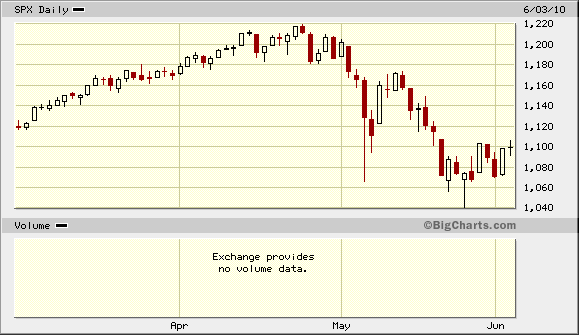
S&P 500 index: can you find the May 6 bungee ride?


Gordon T. Long, "Confirming the Omen of May's Flash Crash"

[excerpt:]

The highly discussed and quickly forgotten Flash Crash [of May 6] was an omen of what lies ahead for the financial markets. It was a uniquely distinctive occurrence relative to anything we've ever experienced. Likewise, what we're about to witness will be startling and never before observed by this generation of investors. After only 30 days the Flash Crash signal has become unambiguous and historians will wonder why the public didn’t react sooner to its clarion call....

It's readily apparent that present-day markets have built across-market dynamic hedging machinery with a hair trigger. This trigger is designed to launch unimaginable trading volumes in less than 250 microseconds, across global exchanges, operating under different and still uncoordinated rules. The activation could be any number of events but my sense is it will stem from the dramatic contraction in money supply. Despite massive central bank actions, money supply as measured by MZM, M1, and M2 is still decelerating and, in the case of the difficult to obtain M3, is contracting....


When a highly leveraged system is built on the basis of liquidity and liquidity is shrinking, it's only a matter of time.

Complete article viewable at Minyanville.com.


Tuesday, June 1, 2010

Road Map for U.S. Markets?


Howard Simons, "Comparing the Nikkei and the NASDAQ"

[excerpt:]

While correlation doesn't imply causality, this is a picture that can really get your attention...

The NASDAQ has failed earlier in time and lower in price than the Nikkei did at a comparable point in its history.

Now comes the real ugly part: If the analog holds, the Nikkei punched down another 61.4% between April 14, 2000 and April 25, 2003.


Complete article viewable at Minyanville.com.


Monday, May 31, 2010

Friday, May 28, 2010

Vital Signs


Is there a pulse?

You decide:


Real Disposable Personal Income

Flatlining.


Initial Unemployment Claims

Stuck at roughly 450K.


Commercial and Industrial Loans

No bounce yet from the recent 20+ percent decline.


MBA Purchase index
(tracks new home mortgages)

Can you tell when the First-time Home Buyer Credit expired (twice)?


TED spread
(difference between LIBOR and US 10-year Treasury yield)

The higher this goes, the closer we get to a seizure in the credit markets.


Wednesday, May 26, 2010

The Bailouts Must End


John P. Hussman, Ph.D., of Hussman Investment Trust:

Treasury Secretary Timothy Geithner has scheduled a trip to Europe this week to urge European leaders "to pay better attention to potential market reactions to policy moves, and to accelerate the European rescue program." This promises to be a fiasco. What could European leaders possibly find more arrogant than to be lectured on bailout policy - not simply by the U.S., but specifically by a one-trick pony bureaucrat whose chief trick is the ability to smoothly talk the language of prudence while simultaneously pillaging the fiscal stability of an entire nation for the benefit of bondholders who made bad loans?

...It would be wise for investors to abandon the fear-mongering word "failure" in preference for the instructive word "restructuring." Thinking of credit strains in terms of failure prompts a natural but improper impulse to avoid that failure through bailouts, at the cost of those who had no part in the mismanagement. In contrast, recognizing the need for restructuring places the costs directly where they belong - on those who provided and managed the capital. It also immediately turns attention to proper solutions and negotiations between the borrowers and lenders.

Complete commentary at HussmanFunds.com.


Monday, May 24, 2010

How about that recovery?

Maine Unemployment Rate Drops in April is what the headline flashed in Friday's Portland Press Herald. From 8.2% all the way down to 8.1%. A mere rounding error. What the story failed to point out is what really matters: 6,500 jobs were lost in Maine in April. As the chart above shows, this U-turn in the jobs number means that we have not even hit bottom yet. Expect another thousand or more jobs to be lost before July 1 as school districts pare down for the coming fiscal year.

Bottom line: the state's revenue projections for FY2011, already bleak, may need to be revised downward once more.

Monday Muse


Maire Brennan

To the Water


Thursday, May 20, 2010

Oh, Yeah? Take That!


"The bottom line is, boycotts work."

--L.A. Mayor Antonio Villaraigosa,
justifying the city council's resolution to punish Arizona
for its new immigration law.


"If an economic boycott is truly what you desire, I will be happy to encourage Arizona utilities to renegotiate your power agreements so Los Angeles no longer receives any power from Arizona-based generation. I am confident that Arizona’s utilities would be happy to take those electrons off your hands."

--Arizona Corporation Commissioner Gary Pierce,
offering in response to re-allocate 25% of L.A.'s power supply


Wednesday, May 19, 2010

He's BA-A-ACK!

Global markets are wilting under this carnivore's breath.

Leo Isaak explains why:

I'll start out by getting right to the point: I'm incredibly bearish right now....

I think Europe could very well destroy any hope of a recovery that we thought we might see. Not only that, I think it could push the world off of a precipice of debt that, if it were to occur, would create something resembling outright disaster. Austerity combined with savage debt service issues and crushing currency devaluation is impacting the entire world... Frankly, I'm nothing short of terrified.


Complete article viewable at Minyanville.com.


Monday, May 17, 2010

Sunday, May 16, 2010

A cynic is a man who, when he smells flowers, looks around for a coffin.
--H.L. Mencken

Friday, May 14, 2010

Gone Clippin'

The pool below Kees Falls sparkles in the afternoon sunlight.
Caribou Trail
W.M.N.F.
05-13-2010

Monday, May 10, 2010

World's Largest Defibrillator: Will It Work?


Yesterday the European Union announced a trillion-dollar plan to rescue the region's weaker economies. In his weekly market comment this morning, John P. Hussman explains why the attempted "shock and awe" will succumb to "aw, shucks."

[excerpt:]

Looking at the current state of the world economy, the underlying reality remains little changed: there is more debt outstanding than is capable of being properly serviced. It's certainly possible to issue government debt in order to bail out one borrower or another (and prevent their bondholders from taking a loss). However, this means that for every dollar of bad debt that should have been wiped off the books, the world economy is left with two - the initial dollar of debt that has been bailed out and must continue to be serviced, and an additional dollar of government debt that was issued to execute the bailout.

Notice also that the capital that is used to provide the bailout goes from the hands of savers into the hands of bondholders who made bad investments. We are not only allocating global savings to governments. We are further allocating global savings precisely to those who were the worst stewards of the world's capital. From a productivity standpoint, this is a nightmare.

Complete article viewable at HussmanFunds.com.


Monday Muse


Judy Collins

Albatross


Sunday, May 9, 2010

Quote for the Week, May 9-15, 2010

If you could kick the person in the pants responsible for most of your trouble, you wouldn't sit for a month.
--Theodore Roosevelt, U.S. President (1901-09)


Saturday, May 8, 2010

Fritz in Fine Form


Interview with former Senator Ernest Hollings (SC)

[excerpt:]

I got elected in 1948. In those days you had to do a good job to get re-elected... Not anymore. I can tell you for that crowd coming into Washington today re-election is the first order of business and that means money. In my last race, I raised $8.5 million which is $30,000 per week, every week for six years... Senator Mike Mansfield used to have a vote on Monday morning to get a quorum for the Senate to do business and would keep us in session until Fridays at 5:00. Not anymore. Mondays and Fridays are gone. We fund-raise. We love filibusters. We get a Republican and a Democrat to hold the floor and the rest go out and fund-raise....

I am as frustrated as any. I speak and write but it has no effect on Larry Summers and Tim Geithner, who sank the trade policy. They want to keep Wall Street and the banks up and Goldman Sachs up. They don't give a damn about jobs or environmental safety or labor in Shanghai. As long as the market's up they think we have a good economy. The market's up my ass. We're broke. Everybody's broke...

It is ridiculous to manage our fiscal affairs in this way. The only way to fix it is to educate the public on what is going on. Rather than a "hue and cry" about Wall Street, we should be talking about how to fix our nation's finances..
. Summers and Geithner ought to be fired immediately.

Complete interview viewable at InstitutionalRiskAnalytics.com.
(free this week only)


Friday, May 7, 2010

ZIRP Should Be Zapped


David Stockman, "Fed Policy Stealing From Our Future"

[excerpt:]

We are now well into the second year of green shoots, but in word and deed the Fed remains entombed in the zero interest rate policy (ZIRP)...[which] is incredibly destructive because it gives precisely the wrong signal to key economic constituencies, including speculators, savers, and politicians....

The risk/reward equation for rank speculation on the yield curve has become downright mouthwatering. Based on the Fed’s promise of no policy surprises, daredevils throughout the financial markets have put on massive carry trades, believing -- perhaps correctly -- that they will have plenty of forewarning when it's time to get out of risk assets. Meanwhile, funded by the Fed’s cornucopia of essentially zero-cost repo, these risk assets are earning handsome spreads and/or valuation gains, thereby minting profits while the speculators wait.

These massive trading gains being reported by Wall Street banks, however, do not represent economic profits from capital deployed in value-added service to the household and business sectors; that is, they are not comparable to returns from underwriting new equity issues for corporations or providing asset management services to households. Rather, they amount to pure rents extracted from valueless, hyperactive trading inside the Fed’s artificially steepened yield curve.

To be sure, the dead-weight economic cost of this pointless churning of the secondary markets in securities and derivatives may not be fatal. But at the end of the day, it does represent a massive, unjustifiable income transfer from the struggling multitudes to the fortunate few, and a demented social policy that forces investors to incur great risks to obtain any return at all on their savings.


Complete article viewable at Minyanville.com.


Thursday, May 6, 2010

Credit Crisis One of Credibility

George Friedman, "The Global Crisis of Legitimacy"

Systemic risk emerges when it appears that the political and legal protections given to economic actors, and particularly to members of the economic elite, have been used to subvert the intent of the system. In other words, the crisis occurs when it appears that the economic elite used the law’s allocation of risk to enrich themselves in ways that undermined the wealth of the nation. Put another way, the crisis occurs when it appears that the financial elite used the politico-legal structure to enrich themselves through systematically imprudent behavior while those engaged in prudent behavior were harmed, with the political elite apparently taking no action to protect the victims....

This is a political crisis then, not an economic one. The political elite is responsible for the corporate elite in a unique fashion: The corporation was a political invention, so by definition, its behavior depends on the political system. But in a deeper sense, the crisis is one of both political and corporate elites, and the perception that by omission or commission they acted together — knowingly engineering the outcome. In a sense, it does not matter whether this is what happened. That it is widely believed that this is what happened alone is the origin of the crisis. This generates a political crisis that in turn is translated into an attack on the economic system.

Complete article viewable at Stratfor.com.


Tuesday, May 4, 2010

These Piggies? Not So Little

Seven more banks were closed by the FDIC on Friday, bringing the total for the year to 64--and the total since January 1, 2009, to over 200. Ho-hum, business as usual, right? Not exactly. What makes Friday's tally noteworthy is the cost to the Deposit Insurance Fund: over $7.3 billion for these seven, compared to $8.6 billion for the previous fifty-seven. So losses to the DIF are accelerating.

The FDIC knew coming into 2010 that a year's worth of premiums from the insured banks would not be enough to cover expected failures. So it billed the banks not only for 2010, but for 2011 and 2012 as well, all of it due last December 31. That meant an infusion of over $45 billion into the DIF, some of which was needed to paper over a deficit from 2009. At the current burn rate, the DIF will be wiped out by the end of July. After that the FDIC will be borrowing from the U.S. Treasury, which itself is so far in the hole that Chinese airspace is almost visible underfoot.

Ever since April 16, short-sellers have been circling Goldman Sachs in a feeding frenzy sparked by a complaint by the Securities Exchange Commission that the firm had defrauded investors. The scary part is that Goldman never thought it was doing anything wrong by peddling synthetic CDOs without transparent disclaimers. It was more business as usual, no moral compass required. Goldman still believes it is clean--godly, even--but at least now it is disclosing legal risks to those who do use a compass. Yesterday the firm revealed that it has been hit with seven lawsuits so far (not counting the SEC's), alleging “breach of fiduciary duty, corporate waste, abuse of control, mismanagement and unjust enrichment.” The plaintiffs allow that, other than those few things, Goldman has done a fine job.

The cost of insuring Goldman's debt (using five-year credit default swaps) has nearly doubled since the SEC announcement, suggesting that investors do not share Goldman's estimation of its own invincibility.

Pollyannas have cheered U.S. auto sales figures for the past two months as proof that the economic recovery has taken hold. However, a glance at the graph below from CalculatedRiskBlog.com confirms that sales are nowhere near the 15-16 million units per year needed to sustain the existing manufacturing capacity. We can detect a Cash-for-Clunkers spike in 2009 and the more recent (and less robust) Toyota-incentives spike. Otherwise we are stuck at a run rate of 10-11 million units annually, about where we were twenty years ago when there were far fewer registered drivers.

[click to enlarge]

Monday, May 3, 2010

Sunday, May 2, 2010

Quote for the Week, May 2-8, 2010

The fundamentalists have taken the fun out of the mental.
--Ken Kesey


Ruptures Everywhere


Twenty acres in western Maine
with gravity-fed springwater
never looked so good....


Friday, April 30, 2010

Ripple Effect of Rig Collapse

View audio slideshow at FT.com.

The BP oil spill in the Gulf of Mexico means that hopes of an economic recovery anytime soon are going up in smoke. Sure, the banksters shuffling monopoly money on Wall Street are getting their own little recovery in quarantine. But for the rest of us dealing with the real world of tangible goods and dwindling resources, life just got tougher. Energy costs must rise to pay for clean-ups, collateral damage, escalating insurance premia, regulatory compliance, and ultimately the migration to a greener fuel mix.

These costs will be a drag on new business investment in the near term, as companies cannot reduce energy consumption as easily as they can, say, headcount. Add to the energy surtax the fiscal drag of over-extended local, state, and federal governments, and you have a recipe for protracted downtime in the U.S. economy.

There is one entity, according to Minyanville's Jeff Macke, that welcomes the spillage:

Exxon, though largely finished with a two-decade legal process, won’t be off the hook for the worst oil spill in history until BP’s spill takes the title sometime in the next few weeks. Somewhere in Exxon offices they’ve got a Gallons Spilled tote board that they are watching the way Jerry Lewis used to watch the donation total board during his telethons. Balloons will drop from Exxon’s corporate ceilings when someone else is officially responsible for the Worst Oil Spill in History.

P.S.--One of the rig workers pulled to safety, Jarod Oldham of Peru, played hoops for me at GRCC during his early grade-school years. Now a strapping 6'6", he was easy to find.


Thursday, April 29, 2010

Jack Bauer Signs In from Baghdad


Scott Stewart, "Jihadists in Iraq: Down For the Count?"

[excerpt:]

This type of rapid, sequential activity against jihadists by U.S. and Iraqi forces is not a coincidence. It is the result of some significant operational changes that were made in 2007 in the wake of the American surge in Iraq. The then-commander of the Joint Special Operations Command (JSOC), Gen. Stanley McChrystal, was instrumental in flattening hierarchies and reducing bureaucratic inefficiencies in both intelligence and special operations forces activities inside Iraq in order to create a highly integrated and streamlined organization. The result was the capability to rapidly plan and execute special operations forces raids based on actionable intelligence with a limited shelf life — and then to rapidly interrogate any captives, quickly analyze any material of intelligence value seized and rapidly re-task forces in a series of follow-on operations. The resulting high tempo of operations was considered enormously successful and a key factor in the success of the surge, and recent developments in Iraq appear to be a continuation of this type of rapid and aggressive activity.

Such operations not only can produce rapid gains in terms of capturing and killing key targets, they also serve to disrupt and disorient the enemy. According to Iraqi Maj. Gen. Qasim Ata, AQI [al Qaeda in Iraq] is currently in disarray and panic, and he believes that the organization is also facing money problems... Following the recent raids in which senior operational commanders and bombmakers have been captured or killed, it also appears that the group may also be facing some leadership and operational-expertise difficulties.

Flattened hierarchies? Enhanced interrogations? Rapid turnarounds? I know who does that. All in 24 hours.

Complete article viewable at Stratfor.com.


Wednesday, April 28, 2010

Up, Up and Away!

Yield on Greece's Ten-Year Bonds

If you are Greek, you do not want to be borrowing money right now, because interest rates are going through the roof. The chart above is actually a few hours out of date. The yield on ten-year bonds issued by the government of Greece reached 9.68 percent yesterday, but that was before Standard & Poor's downgraded Greek debt to BB+, or junk status. Overnight the yield on the ten-year shot up to over 11 percent, more than 800 basis points above the benchmark German bund.

There are no meaningful prices available for Greece's two- and five-year notes, a huge red flag signaling that default is imminent. Portugal may be next, with Spain to follow. The dominoes left standing when this is all done? Your guess is as good as mine.

Tuesday, April 27, 2010

Red Tide

[click to enlarge]

This graphic comes from the Chicago Tribune. The "pink" debt could not be sold by the government to public investors without driving interest rates to punishing levels. Instead, it was swapped for funds held in trust for the citizenry--primarily Medicare and Social Security, which have been funded over the years by employers and employees for future benefits. The government has essentially absconded with these citizen contributions and can only replace the missing money by (you guessed it) taxing citizens. Heads we lose, tails we lose again.


Monday, April 26, 2010

Sunday, April 25, 2010

Quote for the Week, April 25-May 1, 2010

Do not go where the path may lead, go instead where there is no path and leave a trail.
--Ralph Waldo Emerson


Friday, April 23, 2010

Activity Without Productivity


George Soros, "America Must Face Up to the Dangers of Derivatives"

[excerpt:]

Whether or not Goldman is guilty, the transaction in question clearly had no social benefit. It involved a complex synthetic security derived from existing mortgage-backed securities by cloning them into imaginary units that mimicked the originals. This synthetic collateralised debt obligation did not finance the ownership of any additional homes or allocate capital more efficiently; it merely swelled the volume of mortgage-backed securities that lost value when the housing bubble burst. The primary purpose of the transaction was to generate fees and commissions.

This is a clear demonstration of how derivatives and synthetic securities have been used to create imaginary value out of thin air. More triple A CDOs were created than there were underlying triple A assets. This was done on a large scale in spite of the fact that all of the parties involved were sophisticated investors. The process went on for years and culminated in a crash that caused wealth destruction amounting to trillions of dollars. It cannot be allowed to continue.

Complete article viewable at FT.com.


Wednesday, April 21, 2010

Job-Seekers Yield to Rent-Seekers

David Stockman, "Did Washington Save the Economy?"

[excerpt:]

At the end of the day, the central missing ingredient is the absence of any apparent prospect for significant secular growth in most job categories across the US economy. Moreover, that ingredient has been missing for more than a decade now, even if temporarily obscured by the past headlong expansion of the HES [health, education, and social spending] Complex. Here, the underlying reality is that the American consumers’ great spending spree during the Boom years didn’t fund a corresponding cornucopia of jobs on Main Street. Instead, these dollars flowed to the factories of East Asia and to windfall rents captured by speculators in domestic land, resale properties, and financial products. Stated more graphically, the boom-time spending that didn’t end up abroad flowed in the main, not horizontally to the job market multitudes throughout the American hinterlands but vertically into the towering incomes of the Wall Street few.

Not coincidentally, the recent frantic money-printing by Bubbles Ben and his posse hasn’t changed this condition. In the present case, nearly all of the $1.7 trillion monetization of government and agency paper undertaken by the Fed over the past year has literally been sequestered within the canyons of Wall Street. The freshly minted money so beneficently bestowed either sits idle as book entry excess bank reserves at the New York Fed or has flooded the Fed-controlled repo market where it provides zero-cost funding for Wall Street’s manic trading bots and a fresh installment of the bountiful rents they extract.


Complete article viewable at Minyanville.com.


Monday, April 19, 2010

Sunday, April 18, 2010

Quote for the Week, April 18-24, 2010

I have a scheme for stopping war. It's this: no nation is allowed to enter a war till they have paid for the last one.
--Will Rogers


Friday, April 16, 2010

Weekly Wrap

"I'm doing God's work," said Goldman Sachs CEO Lloyd Blankfein in a newspaper interview last November. Today the Securities and Exchange Commission begs to differ, charging Goldman with defrauding investors in (pick a year, any year!) 2007. Specifically, the SEC alleges that the firm peddled a collateralized debt obligation (CDO) structured, and then shorted, by one of its own clients.

The client, hedge fund Paulson & Co., packed the CDO portfolio with residential mortgage-backed securities of the subslime variety, the kind built to fail during the mortgage frenzy of the mid-aughts. Then Paulson paid Goldman $15 million to market the ticking time bomb to well-heeled suckers. Goldman did so, failing to disclose to investors how or by whom the securities were selected. Meanwhile, Paulson purchased credit default swaps from Goldman as a bet that the portfolio would blow up. Which it did. Paulson made about a billion on the deal. The CDO investors were out the same amount.

MIT's Simon Johnson, blogging at baselinescenario.com, calls today's disclosure a watershed moment, the "Ferdinand Pecora moment" for which he has been waiting. He suggests that Blankfein has some explaining to do:

Either Blankfein knew what was going on – and is therefore liable before the law – or he was clueless and therefore incompetent. Either way, the much vaunted risk management and control systems of Goldman, i.e., what is supposed to prevent this kind of thing from happening, are exposed to be what we have long here claimed: bunk.

And don't think Goldman was the only one playing fast and loose. In the words of Minyanville's Jeff Macke: "if Goldman is dirty, Citi is Pig Pen from Peanuts." The selling of financial dark matter was (still is?) an industry-wide problem with consequences yet to be fully suffered.

I wish the SEC had made its announcement 48 hours earlier. Since July I have been trading around a bearish position on the U.S. financial sector, using an inverse exchange-traded fund. The sector nearly imploded in September 2008 before the TARP bailout bought the big banks some time. But with a new wave of mortgage defaults expected this year, I figured that time was about to run out. Silly me. When JP Morgan Chase reported boffo first-quarter earnings on Wednesday and sent bank stocks en fuego, the pain became too great. I sold my ETF shares and started looking for tech longs instead.

Now the bank trade is back on. The SEC announcement comes after a relentless stock-market rally that has left even the bulls scratching their heads. In other words, we were due for a correction anyway. Add to the mix the risk of sovereign debt default (don't forget, Greece cooked its books with interest-rate swaps sold by Goldman Sachs, another piece of God's work) and a broken circle of trust, and we could have a rout on our hands. Options expiration may help prop the market today. Monday, though, could get interesting.

The stock market has been discounting a narrow slice of reality, the relative prosperity of a castle economy. Those inside the walls get to share the free money printed by the Federal Reserve and build their wealth on inflated paper assets. The unemployed and underemployed stranded outside the moat cannot understand what the party is all about. Could it be that the retail-sales boomlet in March was merely an artifact of transitory stimuli? I'm thinking of higher-than-normal tax refunds, redirected mortgage payments by strategic defaulters (the so-called "squatters' stimulus"), extended (for how long?) unemployment benefits, deep auto discounts (the Toyota-defect stimulus), an early Easter, summer-like weather, and temporary census hiring. Take those away, and what do you get?

A double dip.

Monday, April 12, 2010

Monday Muse


Grace Slick

Jefferson Airplane

White Rabbit


Sunday, April 11, 2010

Quote for the Week, April 11-17, 2010

A patriot must always be ready to defend his country against his government.
--Edward Abbey


Friday, April 9, 2010

Weekly Wrap


Barack Obama is leaning on Governor Deval Patrick for a very good reason. Massachusetts, you see, is providing a test run for the kind of healthcare reform that the President envisions on a national scale. If universal health coverage can be made to work in the Bay State, then perhaps it can work in the other 49 states as well. ObamaCare needs CommonwealthCare to succeed.

But Massachusetts is struggling with costs. It has some of the best hospitals in the country--and some of the most expensive. It spends more per capita on healthcare than any other state. Insurance premiums continue to skyrocket. Campaigning for re-election in November, Patrick figures he has to do something to soothe voters. So when insurance carriers filed last month for hefty increases in rates for small-group coverage, Patrick said no.

That's when the sugar hit the fan. The insurers, caught in the same death spiral plaguing small-group pools all across the nation, need the higher premiums to break even. Since April 1 they have stopped enrolling new applicants in Massachusetts until they get a rate structure that makes sense. Patrick's insurance commissioner, on the other hand, has directed them to offer coverage at the old rates. The industry's response: we'll meet you in court.

Yesterday Suffolk Superior Court Judge Stephen E. Neel heard from counsel for the insurers that 2009 base rates are "completely inadequate and completely arbitrary." The Commissioner's office countered that insurers need to file an administrative appeal first before seeking relief in court. That is a delay that the Commissioner can more easily abide because, after all, it is not his bottom line that is hemorrhaging red ink. Judge Neel will decide by Monday whether the insurers must retreat to Square One.

By attempting to cap rate increases, the governor is skirting, not solving, the problem of runaway healthcare costs. As Scot Lehigh remarks in this morning's Boston Globe, "Patrick’s approach is a bit like banging on the TV screen because you don’t like the DVD that’s playing." The problem is embedded in the medical delivery system itself, according to a recent report by Massachusetts AG Martha Coakley. (Remember her? The roadkill plastered to Scott Brown's tire treads?) The insurers are merely messengers.

The crux of the dispute is this: can a government regulator compel private carriers to subsidize services at below-market rates? For that matter, can the government compel consumers to buy the services? And can the government dictate what providers charge for their services? These are all things that ObamaCare proposes to do.

Democrats who are celebrating the new health reform act as "historic" in the same way as Franklin Roosevelt's New Deal legislation in the 1930s should re-read their history. FDR's reform agenda came to a screeching halt when he tried to pack the U.S. Supreme Court. Some things, as today's dealers may soon find out for themselves, just ain't legal.

A cautionary graphic appeared in yesterday's Financial Times:

The graph plots the difference between the interest rate demanded for Greek government bonds compared to that for German bonds. The bigger the difference (or "spread"), the greater the perceived risk of default for Greek debt relative to Germany's (Germany being the safe-haven benchmark within the Euro-zone).

What do I care? asks Joe Six-Pack, I only drink Bud anyways.

See, Joe, here's the deal. A higher debt premium makes it more expensive for Greece to service the debt, thereby impairing its credit standing (Fitch just downgraded Greek debt to BBB-, one notch above junk status), thereby driving rates even higher. It is a vicious feedback cycle over which Greece has absolutely no control. None. At some point the bond vigilantes take over and cause the default that lenders and borrowers both are trying so desperately to avoid. (Think back to Lehman Brothers in September 2008.) Minyanville's James Kostohryz reports today that bank runs have started in Greece, presaging that the end is near. In his words, "If Greece goes down, this is a big deal."

The bigger problem is that there are a raft of countries ready to "go Greek," including (I hafta tell ya, Joe) the U-S-of-A. Through its Zero Interest Rate Policy, the Administration here at home has been able to roll over government debt at historically low rates. But ZIRP can get zapped at any moment, if the bond vigilantes so decide. Earlier this week the rate on 10-year notes flirted with 4%. If we get a breakout on yields, the federal budget deficit (now running at about $1.5 trillion annually) will explode higher.

That makes America's economic recovery a lot like Cinderella's coach at 11:59 p.m. It looks good--until it doesn't.

Monday, April 5, 2010

Sunday, April 4, 2010

Quote for the Week, April 4-10, 2010

A man's silence is wonderful to listen to.
--Thomas Hardy