Wednesday, August 1, 2012

Passages: Icon and Iconoclast


Gore Vidal (1925-2012)

Author of Lincoln, Burr

Antagonist to Bill Buckley


Sunday, July 29, 2012

Quote for the Week, July 29-August 4, 2012


The future is here. It is just not evenly distributed.
--William Gibson


Friday, July 27, 2012

The Snickers Depression


Gonna be here for awhile...


"Sadly, there is no evidence that suggests controlling excessive indebtedness worked better with, than without, the Fed. The relevant point to take from this analysis is that U.S. economic conditions beginning in 2008 were caused by the same conditions that existed in these above mentioned panic years. Therefore, history suggests that over-indebtedness and its resultant slowing of economic activity supports the proposition that a prolonged move to very depressed levels of long-term government yields is probable."  [Read more...]

--Van R. Hoisington & Lacy H. Hunt, PhD.,

Q2 2012


Thursday, July 26, 2012

Wednesday, July 25, 2012

GM: Not So Good for America


The "New GM" hits new lows.
[courtesy ZeroHedge]

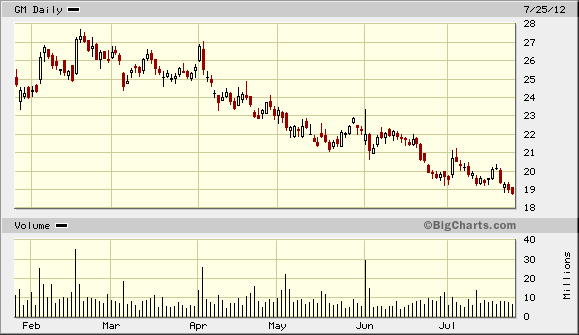
The above graphic from ZeroHedge overlays the trend in unsold inventories at General Motors dealerships with the downward trend in the company's stock price (closing yesterday at about $19 a share).  GM claims to be profitable, but investors aren't fooled.  Revenues have been boosted by channel-stuffing.  It remains to be seen whether the product sitting on dealer lots will actually be sold through to customers.

U.S. taxpayers should care, because they are still invested in the company.  GM took down $50 billion in TARP aid during the first wave of the ongoing Global Financial Crisis.  The firm entered Chapter 11 bankruptcy, crushing equity holders and extracting union concessions.  When GM emerged from bankruptcy in 2009, the U.S. Treasury owned 61% of the company.  An IPO in November 2010 allowed Treasury to sell 35% of the company for $13.6 billion.

When you think of it, Treasury tried to do what Mitt Romney did many times at Bain Capital:  buy up a distressed company, cut costs in draconian fashion, then sell the carcass to retail investors and pension funds.  But "facebooking" the investing public requires skill, and Uncle Sam doesn't have it.  He locked in a partial loss by selling at the IPO price of $33 a share.  Now he needs a share price on the remaining 26% of almost $54 to break even.  And even that will recover neither the interest paid on offsetting Treasury debt during the interim nor the $18 billion in tax-loss carry-forwards gifted to GM.

President Barack Obama has few accomplishments to brag about during his re-election campaign this year.  One has been that he SAVED the U.S. auto industry.  It is true that GM regained some market share when Japanese competitors were dealing with supply-chain constraints brought on by a rather large tsunami and biblical flooding in Thailand.  But the Toyotas and Hondas of the world are back on track.  That turns GM back into what it was before the bail-out.  A pumpkin.

Keep talking, Barry.


P.S.--As of June 30, the MainePERS investment portfolio held 139,712 shares of GM stock, worth $2.65 million today.  The same shares were worth $4.6 million when first offered to the public.  Reality has bitten bigtime.  Maine taxpayers will have to make up the difference.


Six-month chart for GM common
The trend is not our friend.


P.P.S.--Don't look now, but investors are suing GM for false representations in the IPO prospectus.  Say the plaintiffs, statements by GM that the firm was expanding production to meet increased customer demand were "false and misleading, because the increased inventories were the result of channel stuffing and were not attributable to higher demand.  Indeed, at the time of these statements, dealer inventories were rising and trucks were sitting unsold on dealer lots for longer periods of time." Here's the lawsuit:


Monday, July 23, 2012

Quote for the Week, July 22-28


Every great cause begins as a movement, becomes a business, and turns into a racket.
--Eric Hoffer

Friday, July 20, 2012

It's Almost Midnight. Do You Know Where Your Money Is?


Before we return you to your regularly scheduled summering, just think for a moment where your retirement assets are.  If you are a public-school teacher in Maine, or for that matter any state employee, your are partially invested in Wall Street's biggest banks.  And if you are a taxpayer in Maine, you are backstopping those investments.  How do you feel about that?

Are you comfortable that your financial security depends on the continuing hegemony of white-collar racketeers?  Consider the recent headlines.  Peddling fraudulent loans, then securitizing the loans with fraudulent disclosures.  Gouging delinquent borrowers.  Colluding to rig bids in the municipal bond market.  Strong-arming credit-rating agencies.  Buying influence in Congress and in the White House.  Manipulating interest rates.  Front-running markets.  Overcharging clients.  Betting against clients.  The list goes on and on.

The time is coming when the banksters will get theirs.  When they do, equity holders will get crushed, making them both ashamed AND poorer.

MainePERS, smell the coffee.


"Wall Street has so many friends in Washington that meaningful reform is impossible."

--Elizabeth Warren, nominee for U.S. Senate
Washington Post op-ed


Sunday, July 15, 2012

Quote for the Week, July 15-21


If you think a colleague is stupid, refer to him as 'the able, learned and distinguished senator,' but if you know he is stupid, refer to him as 'the very able, learned and distinguished senator.'
--former U.S. Senator Alben Barkley (KY) coaching a freshman senator

Tuesday, July 10, 2012

Watch, Then Vote


Do your due diligence:


Inside Job, Narrated by Matt Damon (Full Length HD).


Monday, July 9, 2012

Quote for the Week, July 8-14, 2012


The greatest enemy of knowledge is not ignorance; it is the illusion of knowledge.
--Stephen Hawkings


Friday, July 6, 2012

Crowding Out Business Investment


"[C]entral governments and the money center banks co-exist in a mutual admiration society where government capitalizes the banks and the banks are the primary buyers of excessive government debt.  Because government doesn't create any real economic value (it regulates it and transfers it from one group to another), the domination of government assets on bank balance sheets in place of private sector assets spells real trouble for the future economic growth in the Western economies."--Robert N. Barone, Ph.D.


Dr. Barone's commentary is viewable at Minyanville.


Sunday, July 1, 2012

Quote for the Week, July 1-7, 2012


Horse sense is the thing a horse has which keeps it from betting on people.
--W.C. Fields

Wednesday, June 27, 2012

Stepping Up Big Time


Robert Caro makes the case, indeed a strong one, that for seven weeks Lyndon Baines Johnson was one of the best U.S. Presidents ever.  In those seven weeks, LBJ brought to the Oval Office a rarely matched blend of vision, humility, acumen, sense of urgency, and composure under stress.  After that, it was back to the same old vanities and insecurities.  But during the difficult time following the JFK assassination, LBJ was The Man.

Lyndon B. Johnson, U.S. President (1963-69)


Caro may have missed the mark in his account of the Cuban missile crisis in 1962.  Slate magazine's Fred Kaplan explains who the real hero was.


Sunday, June 24, 2012

Quote for the Week, June 24-30, 2012


When the entitled elect themselves, the party accelerates, and the brutal hangover is inevitable.
--Dr. Michael Burry


Not all commencement speeches are the same.


Sunday, June 17, 2012

Quote for the Week, June 17-23


I can't decide whether I want to spend my next life as a little alpine bird or as a marmot.  We should be careful before concluding that either of these would be stepping down.
--Randy Morgenson


Monday, June 11, 2012

Quote for the Week, June 10-16, 2012


Anger is an acid that can do more harm to the vessel in which it is stored than to anything on which it is poured.
--Mark Twain


Thursday, June 7, 2012

Iron Lady's Precognition


"What we should grasp, however, from the lessons of European history is that, first, there is nothing necessarily benevolent about programmes of European integration; second, the desire to achieve grand utopian plans often poses a grave threat to freedom; and third, European unity has been tried before, and the outcome was far from happy...
The European single currency is bound to fail, economically, politically and indeed socially...That such an unnecessary and irrational project as building a European superstate was ever embarked upon will seem in future years to be perhaps the greatest folly of the modern era."

--former British Prime Minister Margaret Thatcher, Statecraft (2002)


Sunday, June 3, 2012

Quote for the Week, June 3-9, 2012


The only thing worse than a knee-jerk liberal is a knee-pad conservative.
--Edward Abbey


Thursday, May 31, 2012

Headed for Davy Jones' Locker


Yield on 2-yr. Swiss notes
[courtesy ZeroHedge]


Yields on 2-year Swiss notes have gone negative in a big way.  As ZeroHedge points out, you can now pay the Swiss government 26 basis points to borrow your money.

Why would you do that?

You would if your currency is losing value against the Swiss franc.  And right now the currency of almost two dozen European nations--the euro--is sinking fast.  Switzerland is an island of prosperity in the turbulent European waters and historically a safe haven for scared money.  We have observed that capital is fleeing the beleaguered peripheral nations (Greece, Spain, et al.).  Now we know where a lot of it is going.  The Swiss National Bank has said that it will defend the euro (the Wall Street Journal explains here).  But the chart above (remember, bond yields are inversely related to demand) reveals a widespread belief that the SNB will be unable to hold the fort.


[update, 06-01-12--]


Scared money is also finding its way into German bonds; the two-year yield went negative today.  As David Rosenberg at Gluskin Sheff points out, "the front end of the German curve is seeing huge inflows of euros from the dilapidated banking systems in the south." Rosenberg's recap is a useful primer for uninformed castaways curious about what has been happening in the global economy recently.


John Mauldin, in his weekly newsletter, explains why investors are willing to bid bond yields below zero:
"Buying German bonds, even at a slightly negative rate, is actually a cheap call option on the eurozone breaking up. A German bond that became a new Deutschemark-denominated bond would rise in value at least 40-50% almost overnight."


The Euro: now worth $1.24 and plunging.


Wednesday, May 30, 2012

At the Top of His Game


Dr. John's weekly comment is among his best.


"The Reality of the Situation" [excerpts]:


"Remember that these bouts of QE, LTRO operations, and other interventions have essentially had their effect by squeezing interest rates to levels that are so low that investors feel forced to seek higher risk securities in a search for yield. What Bernanke views as a 'wealth effect' is simply the richer valuation of existing cash flows that goes hand in hand with lower prospective returns in the future. This is not wealth creation, but simply a distortion of the time profile of returns that now leaves investors facing dismal future prospects for investment returns. The economic impact of QE has been restricted to short bursts of pent-up demand, but little more....

We'll finally get some economic traction when global leaders have the sense to take bloated, mismanaged banks into receivership, mark down the assets to their actual value, restructure the repayment terms with homeowners and other borrowers, haircut the liabilities enough to make the resulting entities solvent, and then return them to the private market under a regulatory structure that splits traditional lending from securities trading. That prospect is getting closer....

With respect to Eurobonds, investors should understand that what is really being proposed is a system where all European countries share the collective credit risk of European member countries, allowing each country to issue debt on that collective credit standing, but leaving the more fiscally responsible ones - Germany and a handful of other European states - actually obligated to make good on the debt. This is like 9 broke guys walking up to Warren Buffett and proposing that they all get together so each of them can issue 'Warrenbonds.'"


John Hussman's complete commentary for this week is here.


Sunday, May 27, 2012

Quote For the Week, May 27-June 2


Wealth and want equally harden the human heart.
--Theodore Parker

Friday, May 25, 2012

Caveat Emptor


Has this employee in the London office gotten his pink slip yet?


Sunday, May 20, 2012

Quote for the Week, May 20-26, 2012


[America] is a welfare state, but the welfare is for the elderly, not the poor. While our two parties argue over the haves and have-nots, we are blind to what the nows are doing to the laters.
--Lawrence Kotlikoff and Scott Burns, The Coming Generational Storm

Monday, May 14, 2012

Europe Goes Hard-Core


Citi analyst Willem Buiter paints a doomsday scenario.

"A Greek Exit From the Euro Area:
a Disaster For Greece,
a Crisis For the World"
[excerpt:]


As soon as Greece has exited, we expect the markets will focus on the country or countries most likely to exit next from the euro area. Any non-captive/financially sophisticated owner of a deposit account in that country (or in those countries) will withdraw his deposits from banks in countries deemed at risk - even a small risk - of exit. Any non-captive depositor who fears a non-zero risk of the future introduction of a New Escudo, a New Punt, a New Peseta or a New Lira (to name but the most obvious candidates) would withdraw his deposits from the countries involved at the drop of a hat and deposit them in the handful of countries likely to remain in the euro area no matter what - Germany, Luxembourg, the Netherlands, Austria and Finland...Apart from bank runs in every country deemed, by markets and investors, to be even remotely at risk of exit from the euro area, there would be de facto funding strikes by external investors and lenders for borrowers from these countries....

The funding strike and deposit run out of the periphery euro area member states (defined very broadly), would create financial havoc and mostly like cause a financial crisis followed by a deep recession in the euro area broad periphery. The counterparty inflow of deposits and diversion of funding to the ‘hard core’ euro area and the removal (or at least substantial reduction) of the risk of ECB monetisation of EA sovereign and bank debt would drive up the euro exchange rate. So the remaining euro area members would suffer (at least temporarily) from an uncompetitive exchange rate as well from the spillovers of the financial and economic crises in the broad periphery....

A banking crisis in the euro area and in the EU would most likely result from an exit by Greece from the euro area. The fundamental financial and real economy linkages from the rest of the world to the euro area and the rest of the EU are strong enough to make this a global concern.


Complete paper here.


Sunday, May 13, 2012

Quote for the Week, May 13-19, 2012


The oldest task in human history: to live on a piece of land without spoiling it.
--Aldo Leopold


Friday, May 11, 2012

The Smell of Morgan in the Morning


JPM CEO Jamie Dimon has had better days.


This is more than a wee hiccup.  MainePERS portfolio managers are hurling big time following the disclosure later yesterday afternoon that JP Morgan Chase (ticker symbol: JPM) will be taking investment losses in the second quarter.  How big will those losses be?  The answer (and all you PMs out there, take your ulcer meds first):  no one knows.

JPM is a Top Ten holding in the MainePERS equity portfolio.  Or was.  At the end of the first quarter, MainePERS held 959,294 shares of JPM common stock with a market value of over $44 million.  At that time the shares were priced at about $46 a share.  In pre-market trading this morning, shares are going for around $38.  So in the last six weeks, MainePERS has lost $7.67 million on JPM alone.  The ripple effect on the shares of other Wall Street banks (remember, MainePERS owns 2.5 million shares of Bank of America) compounds the damage.

JP Morgan Chase hastily arranged a conference call with industry analysts at 5 p.m. yesterday, a whiff of panic in the air.  The call coincided with the release of the company's latest 10-Q filing with the SEC.  Scroll down to Page 9 and you will see what the commotion is about:

Since March 31, 2012, CIO [Chief Investment Office] has had significant mark-to-market losses in its synthetic credit portfolio, and this portfolio has proven to be riskier, more volatile and less effective as an economic hedge than the Firm previously believed.

How volatile, you ask?  Is $2 billion vaporized in just six weeks volatile enough for you?  Now, some of that loss has been offset by gains realized through the sale of other securities.  Halfway through the quarter, the net loss for the Corporate unit within the Corporate/Private Equity segment for the whole quarter ending June 30 is estimated at $800 million.  The firm's prior guidance had been for a gain of $200 million.  So that's a billion-dollar swing.

The firm's polished CEO, Jamie Dimon [above], did not hide his displeasure during the conference call. Actually, one wonders why he held the call in the first place.  The 10-Q had been filed and the disclosure made.  The projected loss for Corporate, at first glance, does not appear to be that big of a deal for a firm as big as JPM, which books quarterly profits in the neighborhood of $5 billion.  In the first quarter Corporate showed a loss of $697 million.  That was amply covered many times over by the rest of the company.  So why panic now?

Here's why.  Those synthetic credits are still on the books and may be marked down further.  [Update, 05-17-12:  take off another billion.  And two more.  And two more after that.]  The position is simply too large for the company to disgorge all at once without driving prices down to fire-sale levels.  And now that JPM's hand is exposed, competitors will get in front of the unwind, making the exit even more expensive.  (Bloomberg has the story here.)  The 10-Q says it all:

The Firm is currently repositioning CIO's synthetic credit portfolio, which it is doing in conjunction with its assessment of the Firm's overall credit exposure. As this repositioning is being effected in a manner designed to maximize economic value, CIO may hold certain of its current synthetic credit positions for the longer term.

In other words, Jamie may be stuck in his position, kind of like the Hotel California.  You can check in any time you like, but you can never leave.

Does that make MainePERS stuck as well?


[P.S.--Financial geeks may be interested in this suggestion at ZeroHedge that JPM may be looking at another $3 billion in downside related to the CIO's hedging activities.  "Oh the fun of negative convexity--especially when you ARE the market and there is no one to unwind the actual tranches to."]


[P.P.S.--"I told you so!"  Janet Tavakoli saw this coming two years ago when she warned about "delusional risk-taking and lack of transparency at Too-Big-To-Fail banks," where "ambitious managers strive to pump speculative earnings from zero to hero."  HuffPo has the update here.]


[Lastly, Dr. John Hussman observes:  "Maybe the right question isn't why they lost money on the hedging transaction, but why they apparently have a boatload of questionable assets so massive that they need to use whale-sized leverage to hedge the default risk in the first place."]


Monday, May 7, 2012

Bad Moon Rising

"My view on this is simple - if you've overestimated the long-term stream of cash flows by failing to adjust for elevated profit margins, if the prospective return on stocks is unusually low even on the basis of normalized earnings (as it is today), and if you've set your portfolio up in a crowded trade that takes record-high beta exposure to market fluctuations (as many institutions have now done), you just might be in for some trouble."

--John Hussman, Ph.D. in his weekly Market Comment


Could Dr. Hussman be talking about institutional investors such as (oh, let's just pick one) the Maine Public Employees Retirement System, which is over 60% invested in stocks and whose Top Ten equity holdings include the most "crowded" trade since tulips (Apple), a pharmaceutical giant on the edge of a patent cliff (Johnson & Johnson), and a mega-bank sitting on a ticking debt bomb (JP Morgan Chase)?


Sunday, May 6, 2012

Quote for the Week, May 6-12, 2012


We hang the petty thieves and appoint the great ones to public office.
--Aesop

Friday, May 4, 2012

Where Are the Jobs?


If non-farm payrolls continue to stair-step downward,
Barack had better start packing his stuff.


This morning the Bureau of Labor Statistics released its monthly employment report (or unemployment report, depending on whether you are a glass-is-half-full or glass-is-half-empty kind of person).  Some were disappointed by the numbers.  According to the Establishment Survey, 115,000 nonfarm jobs were added in the U.S. in April [see chart above], the lowest reading so far in 2012 and barely enough to keep up with growth in the working-age population.

The Household Survey told a grimmer story:  235,000 fewer people working at non-agricultural jobs in April compared to the month before.  And if you are not confused enough already, the BLS has another number called the Adjusted Household Survey that shows 495,000 fewer workers month to month.

Whatever the precise quantity of jobs, the quality of jobs leaves much to be desired.  Table A-8 in the household data shows 490,000 more part-time workers in all industries in April even as the overall number of workers declined.  That number is more or less consistent with a data series kept by the St. Louis Federal Reserve Bank showing a gain of 508,000 part-time workers.  The same source records a drop of 812,000 in full-time workers, the largest one-month drop in three years.

The job prospects of one Mitt Romney are soaring.


SIDEBAR:
As for the bank we love to hate, Bank of America filed its latest 10-Q with the SEC yesterday.  Click on the link and scroll down to Page 65 for management's discussion about Credit Ratings.  You will see that Moody's has warned of a possible downgrade to BofA's credit rating, the second in nine months.  The agency's review should be completed by the end of June.

When ratings drop, borrowing costs and demands for collateral rise.  Management quantifies the risk as follows:

At March 31, 2012, if the rating agencies had downgraded their long-term senior debt ratings for the Corporation or certain subsidiaries by one incremental notch, the amount of additional collateral contractually required by derivative contracts and other trading agreements would have been approximately $2.7 billion...If the agencies had downgraded their long-term senior debt ratings for these entities by a second incremental notch, an incremental $2.4 billion...would have been required.

In other words, a potential $5.1 billion loss of liquidity!


Monday, April 30, 2012

Jim Grant Speaks His Mind


Jim Grant speaks.
But will the N.Y. Fed listen?
(March 23, 2012)


[excerpts from "Piece of My Mind":]

"As you prepare to mark the Fed's centenary, may I urge you to reflect on just how far you have wandered from the intentions of the founders? The institution they envisioned would operate passively, through the discount window. It would not create credit but rather liquefy the existing stock of credit by turning good-quality commercial bills into cash— temporarily. This it would do according to the demands of the seasons and the cycle. The Fed would respond to the community, not try to anticipate or lead it. It would not override the price mechanism— as today's Fed seems to do at every available opportunity—but yield to it....


I myself draw more instruction from the depression of 1920-21, a slump as ugly and steep in its way as that of 1929-33, but with the simple and interesting difference that it ended...No TARP, no starving the savers with zero-percent interest rates, no QE, no jimmying up the stock market, no federal 'stimulus' of any kind. Yet—I repeat—the depression ended...[President] Harding's approach worked. The price mechanism is truer and enterprise hardier than the promoters of radical 21st-century intervention seem prepared to acknowledge.


In notable contrast to the Harding method, today's policies seem not to be working. We legislate and regulate and intervene, but still the patient languishes. It's a worldwide failure of the institutions of money and credit."


Full speech here.


Sunday, April 29, 2012

Quote for the Week, April 29-May 5, 2012


Those who have knowledge, don't predict. Those who predict, don't have knowledge.
--Lau-Tzu


Friday, April 27, 2012

GDP Print Disappoints


[click to enlarge]


Examine the colors in the chart above [courtesy of ZeroHedge], particularly the bar on the far right, representing the components of GDP growth in the U.S. economy during the January-through-March quarter.  That is not a palette with which perma-bulls like to paint.  They comprise a school of artists preferring lots of red above the dashed zero line, with smaller splashes of green below that line.  Fixed investment (red) portends future production.  Unsold inventories (green), on the other hand, signal a digestive slowing in production.

Stock market investors started to get excited after last year's Q3 numbers were released--red above, green below.  Share prices went on a four-month tear with hardly a pause.  During the past few weeks, though, volatility has returned as equities have suffered from indigestion.  Now we know why.  The Commerce Department released a preliminary estimate this morning that Q1 GDP grew by 2.2%, failing to match the prior quarter's +3%.  Real final sales rose just 1.6%.  The slowdown came despite the early spring weather, which jump-started home construction and consumer spending (check out the dark blue).

The consumer piece may not be sustainable.  We know that consumer expenditures are outstripping personal disposable incomes, and that cannot last.  Much of the "buying" in the first quarter was actually vendor financing in disguise.  Automobiles drove off dealer lots, adding to GDP, but the subprime lending used to move inventory is not the same as cash-for-chrome.

The primary area of concern is the thin red line in the new bar.  Look left to see the last time we had one of those, one year ago.  The following quarter (Q2 2011) saw just 1.3% growth in GDP.  Estimates for the current quarter (ending June 30) will be coming down after today's release.


Sunday, April 22, 2012

Quote for the Week, April 22-28, 2012


Politics is the art of looking for trouble, finding it everywhere, diagnosing it incorrectly and applying the wrong remedies.
--Groucho Marx


Thursday, April 19, 2012

Honey, I Shrank the Bank


Proud papa lets some of the kids go.


Less is more, according to Bank of America CEO Brian Moynihan, who is scrambling to return his firm to profitability.  Thanks to the Viagra-laced edifice complex of his predecessors, Ken Lewis and, before that, Hugh McColl, BofA had become Too Big To Succeed.  Moynihan hopes to change that.  During the first three months of 2012, the company closed 51 branches and issued 3,103 pink slips.

This morning's Q1 earnings release has confirmed the shrinkage.  Revenue dropped 17% to $22.3 billion from $26.9 billion in the year-ago quarter.  In particular, the firm is retreating from the home-loan business, where it lost $1.1 billion in the first quarter--tough noogies, but actually less painful than the year-earlier loss of $2.4 billion.  According to a February note from FBR Capital Markets, BofA's share of mortgage originations dropped to 5.6 percent in Q4 2011, down from 10 percent the quarter before and nearly 25 percent in 2007.

BofA cannot exit that business fast enough, as liabilities from its ill-starred acquisition of Countrywide Financial continue to mount.  The firm has already paid out $42 billion to settle Countrywide abuses.  Even so, repurchase claims rose in Q1 from $12.6 billion to $16.1 billion--or to $19.2 billion, depending on which footnotes you follow.  Either way, it was a staggering increase.  A mere $282 million has been reserved for those claims, a sign of surrender.  Bank of America is at the mercy of the courts and, absent that, of the taxpayers.

Pressured by federal regulators, BofA reclassified $1.85 billion worth of home-equity loans as nonperforming.  The feds are concerned that falling home prices (amounting to mark-to-market losses nationwide of almost $7 trillion) have wiped out collateral on many second mortgages (e.g. HELOCs), leaving them as unsecured debt.  Up until now, banks have been carrying some of these high-risk junior mortgages at full value.  But auctions of foreclosed properties rarely leave anything for second-lien holders.  So lenders must now account for the risk of total loss.


Nonperforming second liens surge at Bank of America.

Bank of America had earlier identified $4.7 billion of home-equity loans that stand behind a delinquent first.  So more write-downs may be coming.

If I could redesign Bank of America's website, I would do it like this.  But someone has beaten me to it.


[update, 05-01-12--]


2,000 more pink slips at Bank of America.  WSJ story here.


Monday, April 16, 2012

"We Are White-Knuckle Defensive"


"In short, our concern about market risk persists. Our concern about the risk of an oncoming recession persists. Nothing in the recent data has removed my impression that the period ahead may become an unmanageable Goat Rodeo of market volatility, economic disappointments, sovereign debt concerns, and European banking strains."

--John Hussman, Ph.D.,
weekly market comment


Sunday, April 15, 2012

Quote for the Week, Apr. 15-21, 2012


If you set out to be liked, you would be prepared to compromise on anything at any time, and you would achieve nothing.
--Margaret Thatcher, British Prime Minister (1979-1990)


Friday, April 13, 2012

Banks Brag, Investors Flee


Early this morning JP Morgan Chase was the first of Wall Street's mega-banks to report first-quarter earnings. Once again, the firm's highly paid team of accountants came through with a spiffy wax-and-buff job, showing headline numbers that at first glance suggest that business is improving. The shine comes more easily, of course, when the green eye-shades stray from GAAP accounting and invent their own numbers, in this case so-called FTE revenues ("fully taxable-equivalent"), which exploded upward in Q1.

For my money, "FTE" stands for something else: Forget The Explosion. Follow the footnotes instead. Garden-variety revenues rose 6% compared to the depressed year-ago quarter. Modestly positive, but enough to justify the 50% share-price appreciation of the past five months? I don't think so. The company's revenue in Q1 2012, as Peter Atwater at Financial Insyghts observes, "was not much different from Q1 2010--eight quarters of 'recovery' ago!"

Going back down?

Federal incentives and low interest rates have kicked off a refinancing wave in home mortgages, boosting JPM's revenues by $2 billion in the quarter. Don't forget, these new loans replace higher-interest loans, effectively reducing the industry's future cash flows. Whatever business JPM is pulling in by offering refinancing is coming at the expense of competitors, whose legacy loans are being prepaid. Refinancing is a zero-sum game (negative-sum, actually, as rates leak lower). Even after stealing market share in the mortgage industry, Morgan's net income decreased slightly from a year ago.

And it's not like mortgage-lending is suddenly risk-free. JP Morgan Chase reduced its loan-loss reserves by $1.8 billion in Q1, but then added that--and more--right back into a reserve fund to cover future litigation expenses (mortgage-related lawsuits just keep on comin'). The charge: $2.5 billion. According to CEO Jamie Dimon, "we expect to see elevated levels of costs and losses associated with mortgage-related issues for a while longer." Dimon had previously estimated that JPM would be booking an annual profit of $24 billion were it not for all those pesky legal liabilities. Can't a guy make a dishonest profit anymore?

Interestingly, the release of loan-loss reserves came during a quarter when the portfolio value of nonperforming loans increased, reversing a two-year trend. Could be a case of premature evacuation:


Slide from JPM's earnings presentation.


[update, 4 p.m.--]

Another big bank heavily into home loans, Wells Fargo, followed close behind JP Morgan Chase with its own earnings release, which showed a similar increase in revenues (+6.4 % YOY). Wall Street was not impressed. JPM's common stock just closed down for the day, off 3.6%. WFC was right behind, down 3.5%. Look out below.

A skeptical Matt Stoller has more at nakedcapitalism.com: "the status quo of a thinly capitalized servicer model and odd second lien accounting continues."


Sunday, April 8, 2012

Quote for the Week, Apr. 8-14, 2012


Facts and truth really don't have much to do with each other.
--William Faulkner


Friday, April 6, 2012

Jobs Update Disappoints


From Calculated Risk:


Today's Nonfarm Payrolls number from the Bureau of Labor Statistics was a miss, with employment in the U.S. expanding in March by 120,000 jobs, just half the increase observed in either January or February and barely enough to cover the increase in the working-age population. The graph above shows just how anemic the job recovery has been. We are still 5 million jobs short of the cycle high reached in December 2007:

This is a recovery?

What's worse, the new jobs on average pay less than the old ones.


And look who is fighting for those new jobs! John Hussman observes:

"If you dig into the payroll data, the picture that emerges is breathtaking. Since the recession 'ended' in June 2009, total non-farm payrolls in the U.S. have grown by 1.84 million jobs. However, if we look at workers 55 years of age and over, we find that employment in that group has increased by 2.96 million jobs. In contrast, employment among workers under age 55 has actually contracted by 1.12 million jobs. Even over the past year, the vast majority of job creation has been in the 55-and-over group, while employment has been sluggish for all other workers, and has already turned down....

In short, what we've observed in the employment figures is not recovery, but desperation. Having starved savers of interest income, and having repeatedly subjected investors to Fed-induced financial bubbles that create volatility without durable returns, the Fed has successfully provoked job growth of the obligatory, low-wage variety. Over the past year, the majority of this growth has been in the 55-and-over cohort, while growth has turned down among other workers. Meanwhile, overall labor force participation continues to fall as discouraged workers leave the labor force entirely, which is the primary reason the unemployment rate has declined. All of this reflects not health, but despair, and explains why real disposable income has grown by only 0.3% over the past year."[Complete comment here.]

Boomers are NOT leaving the job market.

The latest monthly commentary from IceCap Asset Management of Halifax, Nova Scotia, comes with a title that is apropos: "I Need a Job". The report points out that the number of people working part-time in the U.S. "for economic reasons" (i.e. cannot find full-time work) has doubled from 4 to 8 million so far during the Greater Depression. Moreover, the overall labor force participation rate is trending downward:

% of noninstitutionalized Americans with a job


Sunday, April 1, 2012

Quote for the Week, Apr. 1-7, 2012


I have been impressed with the urgency of doing. Knowing is not enough; we must apply. Being willing is not enough; we must do.
--Leonardo da Vinci


Wednesday, March 28, 2012

Taibbi's Latest Punching Bag


The .01 percenters hate this guy.


Gee, I haven't picked on Bank of America lately. But then again, who can do that better than Rolling Stone scribe Matt Taibbi [above]? Matt, you see, has a thing for crony capitalists--and most particularly for the parasites permeating the financial sector. In this month's article he gives BofA the treatment:


"In sum, Bank of America torched dozens of institutional investors with billions in worthless loans, repeatedly refused to abide by contractual obligations to buy them back, evaded hundreds of millions in local fees and taxes, pushed tens of thousands of people into foreclosure using phony documents, ignored multiple court orders to stop its illegal robo-signing, and exploited President Obama's signature mortgage-relief program. The bank fixed the bids on bonds for schools and cities and utilities all over America, and even conspired to try to game the game itself – by fixing global interest rates!"


In other words, BofA outdid the squid. Complete story here.


Monday, March 26, 2012

Jayhawks in Final Four


KU vs. OSU
tip-off, 8:49 p.m. Saturday
B THR OR B √


Sunday, March 25, 2012

Quote for the Week, Mar. 25-31, 2012


Private property loses its legitimacy if too unequally distributed, and markets lose their legitimacy if prices do not tell the whole truth about costs.
--Herman Daly


Friday, March 23, 2012

Zach Attack


Zach Hine wins St. Patrick's Day 10-K
Holyoke, MA
03-17-12


Sunday, March 18, 2012

Quote for the Week, Mar. 18-24, 2012


Democracy must be something more than two wolves and a sheep voting on what to have for dinner.
--James Bovard


Thursday, March 15, 2012

Called on Account of Global Warming


Drying up already?
Tapped on Valentine's Day.
Done by St. Patrick's Day.
Welcome to the New Normal.
Time to reschedule Maine Maple Sunday?


Sunday, March 11, 2012

Quote for the Week, Mar. 11-17, 2012


When plunder becomes a way of life for a group of men living together in a society, they create for themselves in the course of time a legal system that authorizes it and a moral code that glorifies it.
--Frederic Bastiat