Monday, October 22, 2012

Former VP Rips Squid


"The quickest way to make money on Wall Street is to take THE most sophisticated product and try to sell it to the least sophisticated client."

--Greg Smith, author of Why I left Goldman Sachs,
to 60 Minutes


Sunday, October 21, 2012

Quote for the Week, October 21-27, 2012


I cannot imagine why anybody would give money to the U.S. government for 30 years for less than a 4% yield. I certainly wouldn't.
--Jim Rogers


Tuesday, October 16, 2012

Tuesday Tune-up


Tift Merritt, "Broken"


Sunday, October 14, 2012

Quote for the Week, October 14-20, 2012


Politics is the art of looking for trouble, finding it everywhere, diagnosing it incorrectly and applying the wrong remedies.
--Groucho Marx


Saturday, October 13, 2012

Watch, Then Vote


Homework for November 6:


Inside Job, narrated by Matt Damon.

This movie gets taken down from time to time by The Powers That Be, but now it's back (with Spanish subtitles).  Catch this before it gets away.


Friday, October 12, 2012

JPM Underwhelms with Q3 Earnings


CEO Dimon:  feeling the heat?


This morning's headlines say it's a beat.  But the third-quarter earnings report from JP Morgan Chase leaves a lot more to be desired than just transparency.  The capsule summary from ZeroHedge:

"[T]he bottom line is this: revenues from trading dropped both sequentially and Q/Q while banking expenses rose, Net Interest Margin dropped to a new record low, even as the firm took a major $967 million loan loss reserve release on its loans to $22.8 billion, even as its total Non-Performing Loans rose by a whopping $1.3 billion to $11.370 billion, the largest quarterly jump in years!"

In other words, business is not exactly booming at this top-tier investment bank.  We might have guessed that a lackluster report was coming simply by listening to CEO Jamie Dimon's sour-grapes speech two days ago, when he insisted (regarding his firm's takeover of Bear Stearns in 2008) that the devil made him do it.  Make that devils, plural.  You know, Treasury Secretary Hank Paulson, Fed Chairman Ben Bernanke, the usual suspects.  "We did them a favor," Dimon said in D.C. on Wednesday.  "We were asked to do it and we did it at great risk to ourselves."

But that's not what Dimon was saying in March 2008, when he described the takeover as "good long-term value for J.P. Morgan Chase shareholders."  He then went on to say, "This acquisition meets our key criteria:  we are taking reasonable risk, we have built in an appropriate margin for error [i.e. we underpaid, heh-heh], it strengthens our business, and we have a clear ability to execute."

Yeah, clearly.  Dimon now claims that losses from the acquisition have run in the billions--and counting, what with state attorneys general launching litigation left and right.  Diamond Jim is being disingenuous, moreover, with the later assertion that risk came looking for him, and not vice versa.  Billions more have been lost as JPM unwinds the infamous London Whale trade.  And now we learn from this morning's report that the company in one quarter almost doubled its exposure (now close to $12 billion) to the sovereign debt of the stressed peripheral nations of Europe--a dice roll if there ever was one.  Whales, PIIGS, you name it, Dimon is rooting for profits in all the wrong places.

Bank analyst Christopher Whalen suggests here that Jamie needs a little adult supervision.  Either that or a freshly minted stack of resumés for his next job search.  Bank compliance expert Michael Crimmins is of the opinion that Dimon deserves not just a pink slip, but an orange jumpsuit.  The Whale Tale, in his view, reveals "glaring deficiencies in internal controls [at JPM] that warrant prosecution of Jamie Dimon under Sarbanes Oxley."  Remember that, in case Obama/Biden need to shag a few more votes going into the November election.

As for JPM's failed business model, Reggie Middleton and Max Keiser share some thoughts here:


[update, 10-15-12--]

Next up, Citigroup, whose Q3 report this morning used many of the same accounting gimmicks as JPM to make lemonade out of lemons.  ZeroHedge scrubs C's financials here.


[update, next day--]

Citi's Chief Executive Officer and Chief Operating Officer are given the heave-ho.  Some quarter.  Some company.


Push-Button Slaughter


It takes a single drone to raze a village.


Wednesday, October 10, 2012

The Case of the Missing Jobless


On Friday the Bureau of Labor Statistics reported that the nation's unemployment rate dropped below 8% in September.  This would appear to be, if not the best of news, at least not so bad--and a tonic for President Obama's campaign for re-election.  At last, progress!  Naturally, skeptics immediately claimed that government bureaucrats had cooked the books to make the Prez look good.  Nonsense, say the Big O's apologists, who insist that the statistical downtick, coming just one month before Election Day, was but a coinky-dink.

Yes or no?  Were the data manipulated?  On that topic John Mauldin's discussion is as careful and nuanced as any.  But whichever numbers you use, three things are clear:


1.  Fewer than half the jobs lost since December 2007 have been recovered.


2.  The new jobs do not pay as much.


3.  Earners are down, dependents are up.

All of which mean that government revenues will not be catching up to expenditures anytime soon.


Tuesday, October 9, 2012

Tuesday Tune-up


Thalía (w/ Joan Sebastian),
"Con La Duda"


Monday, October 8, 2012

Holiday Hike


Webb Lake from the summit of
Blueberry Mtn., Weld
October 8, 2012
[photo: Cathy Hazelton]


Sunday, October 7, 2012

The Fed Pushes on a String...


...but who's pulling it?


"Watergate was actually not a Nixon operation at all, but a deep, deep covert operation against Nixon--seeking to protect the prerogatives and secrets of a group accountable to no one...Nixon was 'paranoid' about the CIA.  He imagined that agency operatives were everywhere, working to undermine him.  Was he crazy, or was he right?

"...a perceptual gap is the essence of the Bush enterprise.  The actuality has tended toward wars for resources and the preservation of class prerogative, all abetted by secrecy, intimidation, and the dark arts of both psychological and covert ops."

--Russ Baker, Family of Secrets


Quote for the Week, October 7-13, 2012


I am a man of fixed and unbending principles, the first of which is to be flexible at all times.
--Everett M. Dirkson (and later echoed by Mitt Romney)


Thursday, October 4, 2012

Etchings


mill pond on Spears Stream
West Peru
[photo: Erin Cox]

Check out Erin's FaceBook gallery.


Wednesday, October 3, 2012

"It Takes Time"


Listen to Kyle Bass, and you will realize that those clouds on the economic horizon have a lining of lead, not silver.  His goal as fiduciary:  not to lose money.


Tuesday, October 2, 2012

Deja Vu All Over Again


Banksters may want to put that cigar away.


News that rocked the financial world four years ago is about to be recycled.  Last night came word that New York Attorney General Eric Schneiderman has filed a civil suit against one of Wall Street's biggest banks, JP Morgan Chase & Co., for "multiple fraudulent and deceptive acts" in peddling residential mortgage-backed securities (RMBS) to investors from 2005 to 2007.  The fraud was actually perpetrated by Bear Stearns, which was close to bankruptcy when JP Morgan Chase took it over in May 2008, thereby inheriting the legacy liability.

The takeover had started with a low-ball bid from Morgan of a scant $2 a share.  Once the U.S. Federal Reserve agreed to offload $29 billion in toxic assets from Bear's balance sheet, the deal got done at $10 a share.  As Bear was going under, I was following the action here and asking whether two other investment banks, Lehman Brothers and Merrill Lynch, might be next.  Their turn came several months later ("Merrill, Lehman Are Goners").  Lehman was simply allowed to fail.  Merrill Lynch was "saved" by a shotgun wedding with Bank of America.

In taking on Merrill Lynch, BofA overpaid.  Taxpayers took some of the sting away (you remember agreeing to this, right?) by offering two tranches of TARP money adding up to $45 billion.  But even those sweeteners could not offset the deficiencies on Merrill's balance sheet, which were hidden from BofA shareholders until after they were coaxed by management to approve the merger ("Good Money After Bad").  BofA was eventually sued for the lack of disclosure, and in February 2010 the Securities and Exchange Commission settled with the company for $150 million.

Peanuts, said federal district judge Jed S. Rakoff, who, even as he approved the settlement, chastened the SEC for not extracting more.  Well, BofA shareholders have picked up where the regulators left off.  Last Friday the company settled a class-action suit over the Merrill Lynch acquisition for $2.43 billion (the N.Y. Times has the lowdown and a look-back here).  Upon the announcement, a loud "That's what I'm talking about!" echoed through the canyons of Lower Manhattan, originating apparently from the Pearl Street address where Judge Jed holds court.

But that will not be the end of the litigation for BofA.  The NY AG warns [see Schneiderman's interview with Bloomberg TV here] that the new charges against Morgan will be replicated against those of Morgan's peers who were also playing fast and loose with RMBS in the go-go aughts.  If the charges stick, settlements could run in the tens of billions to cover investors' losses.  Either that, or, as Christopher Whalen suggests, the banks will have to buy back the tainted securities:


"So what happens with JPM and Bear?  One word: rescission.  My guess is that the fraud perpetrated by Bear Stearns in creating these rancid securities will eventually force JPM to repurchase some of the bonds from investors.  That is tens or even hundreds of billions of dollars of face amount of bad securities." 


[update 10-10-12--]

A U.S. district attorney in New York has just sued Wells Fargo for mortgage fraud, issuing a statement that "yet another bank has engaged in a longstanding and reckless trifecta of deficient training, deficient underwriting and deficient disclosure, all while relying on the convenient backstop of government insurance."  Earlier this year the same office settled three similar suits against other banks for a total of almost a half-billion dollars.  [Story here.]


Sunday, September 30, 2012

Quote for the Week, September 30-October 6, 2012


Wealth consists not in having great possessions, but in having few wants.
--Epictetus


Wednesday, September 26, 2012

Bair Shares


Former FDIC Chair Sheila Bair takes on the Bailouter in Chief in her new book, Bull By the Horns.


Tuesday, September 25, 2012

Golden Goose Is Flatlining


[BloombergBriefs via ZeroHedge]

"One risk to the U.S. economy is that rising entitlement spending will require the government to borrow from the finite amount of capital held by private savers, thus squeezing out private firms that need the capital to expand businesses and increase productivity."


Sunday, September 23, 2012

Quote for the Week, September 23-29, 2012


A comparison with Congress in this case might be deemed an insult to drunken sailors.
--Richard Fisher, President,
Federal Reserve Bank of Dallas,
in remarks to the Harvard Club of NYC, Sept. 19, 2012


Friday, September 21, 2012

Greater Depression? You Decide.


"Velocity of money is the frequency with which a unit of money is spent on new goods and services. It is a far better indicator of economic activity than GDP, consumer prices, the stock market, or sales of men’s underwear (which Greenspan was fond of ogling). In a healthy economy, the same dollar is collected as payment and subsequently spent many times over.  In a depression, the velocity of money  goes catatonic. Velocity of money is calculated by simply dividing GDP by a given money supply. This VoM chart using monetary base should end any discussion of what 'this' is and whether or not anybody should be using the word 'recovery' with a straight face:


"In just four short years, our 'enlightened' policy-makers have slowed money velocity to depths never seen in the Great Depression...The path we’re on ends with mountains of corpses when the great experiment fails."

And what experiment is that?  According to Jim Grant, we have met the lab rats, and They 'R Us:


Thursday, September 20, 2012

Memo to Employees: See a Shrink


The Wall Street Journal is reporting today that Bank of America will terminate 16,000 employees between now Happy New Year's.  This continues a trend that I highlighted five months ago here.  [If you type "Brian Moynihan" into the Search bar above, then hit the spy glass, you will find a list of postings explaining why BofA's CEO has the world's worst job.]

Gentle reminder:  if you work for the State of Maine (or any of its public schools) or pay taxes in Maine, you own this company.


Meet Oscar


With his back to the goal?
From outside the box?
Are you kidding me?


Tuesday, September 18, 2012

China's Economy No Longer on a Roll


[Reuters]

ZeroHedge has a must-read on "The Case of the Missing Steel."  Citing a Reuters article on the slowdown in China's steel industry, ZeroHedge makes the broader claim that the entire global economy is an inverted pyramid balanced precariously on a shrinking base of worthless collateral:

[W]e have been warning for years that i) the inventory of the world's credible assets is literally evaporating in absence of technological efficiency and CapEx spending (which is also the reason for the ECB's endless lowering of collateral requirements) and ii) illegal rehypothecation of assets, which infinitely dilutes claims on real assets, can and will lead to total losses even for investors who thought they had strong collateral backing.

We now know that this has been happening in China with the most critical component of its economic growth miracle: steel. We will soon discover that all other assets: stocks, bonds, commodities (including gold and silver) and finally cash (think deposits) have been comparably rehypothecated and criminally commingled. The end result will be the most epic bank run in world history....

Complete article here.


Monday, September 17, 2012

The Presidentials: Take Two


Lakes of the Clouds from Mt. Washington
September 11, 2012
[photo: Christopher Childs]


Quote for the Week, September 16-22, 2012


Just remember our government has power only because We the People lend it to them. Maybe it's time to treat them like the subprime borrower they are and recall that loan.
--Glenn Beck


Monday, September 10, 2012

Stockman's Back


...and is sticking it to both the Democrats and the Republicans, whom he describes as the "two Free Lunch parties."  His biggest voodoo pins, though, are saved for the "lunatics" at the Federal Reserve.  A former OMB Director in the Reagan White House, David Stockman is looking for any presidential candidate who promises to "clean house at the Fed," starting with a pink slip for Fed Chair Ben Bernanke.  By artificially suppressing interest rates, the Fed is "crushing savers" merely to "placate the little boys and girls [on Wall Street] who want a little more."

Stockman also has some good ideas about where to start on the federal deficit.  A scintillating interview:


Sunday, September 9, 2012

Quote for the Week, September 9-15, 2012


Politics seems to stimulate the reptilian part of the brain, the most primitive part.
--Doug Casey


Saturday, September 8, 2012

What September in N.E. Is For


Hiking in the Presidentials
Friday, September 7, 2012
Mt. Washington behind Mt. Clay
[photo: Cathy Hazelton]


Wednesday, September 5, 2012

Gross: Expect Stunted Returns


PIMCO's Bill Gross


This month's Investment Outlook from PIMCO's managing director and co-CIO includes a sobering view of the prospects for America's banking industry in the years ahead:

"When yields are too low, and acceptable risk spreads so narrow that top line interest revenue is increasingly marginalized, then lending is at risk. Excessive historical overhead represented by rents, salaries, pension and health benefits, to name just a few, force financial and lending institutions to do one of two things: They lever up to cover those costs or they slow or shut lending down to preserve equity and the ultimate franchise...

"Our entire finance-based monetary system – led by banks but typified by insurance companies, investment management firms and hedge funds as well – is based on an acceptable level of carry and the expectation of earning it. When credit is priced such that carry is no longer as profitable at a customary amount of leverage/risk, then the system will stall, list, or perhaps even tip over."


And a final caveat for pension-fund managers (including those at MainePERS):

"The age of credit expansion which led to double-digit portfolio returns is over."


Sunday, September 2, 2012

Quote for the Week, September 2-8, 2012


Have you ever watched a crab on the shore crawling backward in search of the Atlantic Ocean, and missing?  That's the way the mind of man operates.
--H.L. Mencken


Thursday, August 30, 2012

I KNEW I Had Seen Him Before


Then...

...and now.

As Paul Ryan accepted his party's nomination for Vice-President of the U.S. in Tampa last night, computerized fact-checkers monitoring his speech began exploding like Chinese firecrackers.  Here is what fried the hardware.

The jaw-dropping performance earned a special nod from Andy Borowitz.

Remarks Eugene Robinson of the Washington Post, "anyone who hoped Ryan might elevate the debate should be bitterly disappointed."


[update, 09-04-12--]

Andy can't help it.  There is just too much material here.  Not only does Paul Ryan run 7-minute-per-mile marathons, but he moonlights as a Navy Seal.  Check out this special assignment.


© The New Yorker


Monday, August 27, 2012

When Day Traders Occupied Wall Street


"They were Maschler's bandit army, the rejects of Wall Street, the city college kids from the backwaters of Staten Island, Queens, and the Bronx, the ones who didn't stand a chance at a big bank like Goldman or Morgan.  Dumb boiler-room mutts--but they had a secret weapon:  Josh Levine.  With Levine creations such as the Watcher and the Monster Key at their fingertips, they could out-trade the very best in the business.  They could grind Goldman to a pulp. They could make Morgan cry."  [page 100]

It was about time.


Sunday, August 26, 2012

Quote for the Week, Aug. 26-Sept. 1, 2012


The natural progress of things is for liberty to yield and government to gain ground.
--Thomas Jefferson


Sunday, August 19, 2012

Quote for the Week, August 19-25, 2012


“I don’t want to be one of those émigrés of 1917, sipping wine by the Mediterranean and waiting for Russia to get better so I can come back. I have no choice but to do it myself.”
--political activist Maria Baronova


Wednesday, August 15, 2012

The Hedgies and the Banks


As guarantors of MainePERS--and of all the benefits that MainePERS will pay out now and forevermore--we taxpayers have an interest in how the MainePERS investment portfolio performs.  The better the performance, the less we will have to pay out of the General Fund in the future to address pension liabilities.

Here's the problem.  MainePERS has adopted a passive, indexed investment style, which works great in bull markets, but underperforms in bear markets.  MainePERS does not try to time the market.  We ride stocks up, then ride them down.  Financial-sector stocks were big winners in the bubble-licious mid-00s, but have been losers since.  As of June 30 of this year, we still held 926,049 shares of JPMorgan Chase (valued then at over $33 million) and 2,616,812 shares of Bank of America (worth over $21 million).

A year ago we took a look at how three noted hedge-fund managers were handling their investments in Bank of America ("Duck, Duck, GOOSE!").  Unlike MainePERS, these guys DO trade in and out.  When they sense that a firm's business is about to sour, they don't wait for public disclosures from company executives.  They take the money and run.  By the end of 2011 all three had liquidated their entire positions in Bank of America's common stock.

Second-quarter 13-F filings with the Securities & Exchange Commission have just been made public, so we can once again look over the shoulders of the hedge honchos to see what they are doing.  Here's the rundown:

David Tepper, Appaloosa Management LP

Bought almost 7.5 million shares of BAC in Q1, then changed his mind (oops) and sold almost half in Q2.  Cancel that rebound in BAC's business.


John Paulson, Paulson & Co. Inc.

Still has BAC warrants.  Established a new position in JPM (4 million shares) just as the firm was disclosing a trading loss of $5.8 billion (double oops).


George Soros, Soros Fund Management LLC

Exited JPM completely (over 600,000 shares).  Remains BAC-free.  Smart man.


Tuesday, August 14, 2012

Quote for the Week, August 12-18, 2012


"The longer Congress continues to dither, the greater the likelihood of cascading structural impediments to growth and job creation. This can be seen in how much harder it is for those who are struggling to maintain even routine activities, while those who are substantially better off have become way too cautious, preferring to self-insure by holding large balances of cash rather than hiring and reinvesting in plants and equipment."

--Mohamed A. El-Erian, in a Washington Post op-ed


Friday, August 10, 2012

Summer Snapshot


Mt. Katahdin from Katahdin Lake outlet
August 8, 2012
[photo: Cathy Hazelton]


Kudos to Huber Resources Corp. for the donation earlier this year of this priceless waterfront to Baxter State Park.
[MaineToday coverage here.]


Watch Katahdin Lake Land Donation on PBS. See more from MPBN News.


painting by 19th-century artist Frederic Church from the same spot


Sunday, August 5, 2012

Quote for the Week, August 5-11, 2012


If both factions, or neither, shall abuse you, you will probably be about right.  Beware of being assailed by one, and praised by the other.
--Abraham Lincoln


Wednesday, August 1, 2012

Passages: Icon and Iconoclast


Gore Vidal (1925-2012)

Author of Lincoln, Burr

Antagonist to Bill Buckley


Sunday, July 29, 2012

Quote for the Week, July 29-August 4, 2012


The future is here. It is just not evenly distributed.
--William Gibson


Friday, July 27, 2012

The Snickers Depression


Gonna be here for awhile...


"Sadly, there is no evidence that suggests controlling excessive indebtedness worked better with, than without, the Fed. The relevant point to take from this analysis is that U.S. economic conditions beginning in 2008 were caused by the same conditions that existed in these above mentioned panic years. Therefore, history suggests that over-indebtedness and its resultant slowing of economic activity supports the proposition that a prolonged move to very depressed levels of long-term government yields is probable."  [Read more...]

--Van R. Hoisington & Lacy H. Hunt, PhD.,

Q2 2012


Thursday, July 26, 2012

Wednesday, July 25, 2012

GM: Not So Good for America


The "New GM" hits new lows.
[courtesy ZeroHedge]

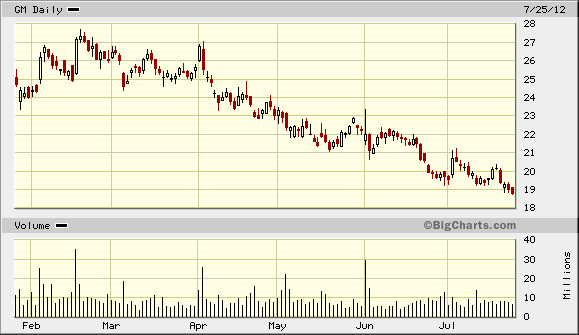
The above graphic from ZeroHedge overlays the trend in unsold inventories at General Motors dealerships with the downward trend in the company's stock price (closing yesterday at about $19 a share).  GM claims to be profitable, but investors aren't fooled.  Revenues have been boosted by channel-stuffing.  It remains to be seen whether the product sitting on dealer lots will actually be sold through to customers.

U.S. taxpayers should care, because they are still invested in the company.  GM took down $50 billion in TARP aid during the first wave of the ongoing Global Financial Crisis.  The firm entered Chapter 11 bankruptcy, crushing equity holders and extracting union concessions.  When GM emerged from bankruptcy in 2009, the U.S. Treasury owned 61% of the company.  An IPO in November 2010 allowed Treasury to sell 35% of the company for $13.6 billion.

When you think of it, Treasury tried to do what Mitt Romney did many times at Bain Capital:  buy up a distressed company, cut costs in draconian fashion, then sell the carcass to retail investors and pension funds.  But "facebooking" the investing public requires skill, and Uncle Sam doesn't have it.  He locked in a partial loss by selling at the IPO price of $33 a share.  Now he needs a share price on the remaining 26% of almost $54 to break even.  And even that will recover neither the interest paid on offsetting Treasury debt during the interim nor the $18 billion in tax-loss carry-forwards gifted to GM.

President Barack Obama has few accomplishments to brag about during his re-election campaign this year.  One has been that he SAVED the U.S. auto industry.  It is true that GM regained some market share when Japanese competitors were dealing with supply-chain constraints brought on by a rather large tsunami and biblical flooding in Thailand.  But the Toyotas and Hondas of the world are back on track.  That turns GM back into what it was before the bail-out.  A pumpkin.

Keep talking, Barry.


P.S.--As of June 30, the MainePERS investment portfolio held 139,712 shares of GM stock, worth $2.65 million today.  The same shares were worth $4.6 million when first offered to the public.  Reality has bitten bigtime.  Maine taxpayers will have to make up the difference.


Six-month chart for GM common
The trend is not our friend.


P.P.S.--Don't look now, but investors are suing GM for false representations in the IPO prospectus.  Say the plaintiffs, statements by GM that the firm was expanding production to meet increased customer demand were "false and misleading, because the increased inventories were the result of channel stuffing and were not attributable to higher demand.  Indeed, at the time of these statements, dealer inventories were rising and trucks were sitting unsold on dealer lots for longer periods of time." Here's the lawsuit:


Monday, July 23, 2012

Quote for the Week, July 22-28


Every great cause begins as a movement, becomes a business, and turns into a racket.
--Eric Hoffer

Friday, July 20, 2012

It's Almost Midnight. Do You Know Where Your Money Is?


Before we return you to your regularly scheduled summering, just think for a moment where your retirement assets are.  If you are a public-school teacher in Maine, or for that matter any state employee, your are partially invested in Wall Street's biggest banks.  And if you are a taxpayer in Maine, you are backstopping those investments.  How do you feel about that?

Are you comfortable that your financial security depends on the continuing hegemony of white-collar racketeers?  Consider the recent headlines.  Peddling fraudulent loans, then securitizing the loans with fraudulent disclosures.  Gouging delinquent borrowers.  Colluding to rig bids in the municipal bond market.  Strong-arming credit-rating agencies.  Buying influence in Congress and in the White House.  Manipulating interest rates.  Front-running markets.  Overcharging clients.  Betting against clients.  The list goes on and on.

The time is coming when the banksters will get theirs.  When they do, equity holders will get crushed, making them both ashamed AND poorer.

MainePERS, smell the coffee.


"Wall Street has so many friends in Washington that meaningful reform is impossible."

--Elizabeth Warren, nominee for U.S. Senate
Washington Post op-ed


Sunday, July 15, 2012

Quote for the Week, July 15-21


If you think a colleague is stupid, refer to him as 'the able, learned and distinguished senator,' but if you know he is stupid, refer to him as 'the very able, learned and distinguished senator.'
--former U.S. Senator Alben Barkley (KY) coaching a freshman senator

Tuesday, July 10, 2012

Watch, Then Vote


Do your due diligence:


Inside Job, Narrated by Matt Damon (Full Length HD).


Monday, July 9, 2012

Quote for the Week, July 8-14, 2012


The greatest enemy of knowledge is not ignorance; it is the illusion of knowledge.
--Stephen Hawkings


Friday, July 6, 2012

Crowding Out Business Investment


"[C]entral governments and the money center banks co-exist in a mutual admiration society where government capitalizes the banks and the banks are the primary buyers of excessive government debt.  Because government doesn't create any real economic value (it regulates it and transfers it from one group to another), the domination of government assets on bank balance sheets in place of private sector assets spells real trouble for the future economic growth in the Western economies."--Robert N. Barone, Ph.D.


Dr. Barone's commentary is viewable at Minyanville.


Sunday, July 1, 2012

Quote for the Week, July 1-7, 2012


Horse sense is the thing a horse has which keeps it from betting on people.
--W.C. Fields

Wednesday, June 27, 2012

Stepping Up Big Time


Robert Caro makes the case, indeed a strong one, that for seven weeks Lyndon Baines Johnson was one of the best U.S. Presidents ever.  In those seven weeks, LBJ brought to the Oval Office a rarely matched blend of vision, humility, acumen, sense of urgency, and composure under stress.  After that, it was back to the same old vanities and insecurities.  But during the difficult time following the JFK assassination, LBJ was The Man.

Lyndon B. Johnson, U.S. President (1963-69)


Caro may have missed the mark in his account of the Cuban missile crisis in 1962.  Slate magazine's Fred Kaplan explains who the real hero was.


Sunday, June 24, 2012

Quote for the Week, June 24-30, 2012


When the entitled elect themselves, the party accelerates, and the brutal hangover is inevitable.
--Dr. Michael Burry


Not all commencement speeches are the same.


Sunday, June 17, 2012

Quote for the Week, June 17-23


I can't decide whether I want to spend my next life as a little alpine bird or as a marmot.  We should be careful before concluding that either of these would be stepping down.
--Randy Morgenson


Monday, June 11, 2012

Quote for the Week, June 10-16, 2012


Anger is an acid that can do more harm to the vessel in which it is stored than to anything on which it is poured.
--Mark Twain


Thursday, June 7, 2012

Iron Lady's Precognition


"What we should grasp, however, from the lessons of European history is that, first, there is nothing necessarily benevolent about programmes of European integration; second, the desire to achieve grand utopian plans often poses a grave threat to freedom; and third, European unity has been tried before, and the outcome was far from happy...
The European single currency is bound to fail, economically, politically and indeed socially...That such an unnecessary and irrational project as building a European superstate was ever embarked upon will seem in future years to be perhaps the greatest folly of the modern era."

--former British Prime Minister Margaret Thatcher, Statecraft (2002)


Sunday, June 3, 2012

Quote for the Week, June 3-9, 2012


The only thing worse than a knee-jerk liberal is a knee-pad conservative.
--Edward Abbey