


Friday, November 20, 2009

Wednesday, November 18, 2009
Mortgage Apps Rolling Over
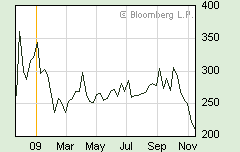 MBA Purchase Index hits a 12-year low.
Wednesday is "Hump Day" for a reason. That's the day we get our weekly reminder from the Mortgage Bankers Association that, for more and more Americans, the prospect of home ownership is a hill too high to climb. Featured periodically in this column, the MBA's Market Composite Index tracks the volume of loan applications for both new mortgages and the refinancing of existing mortgages. That index was down 2.5% from the week earlier on a seasonally adjusted basis.
Almost three of every four loan applications are for refinancing, not surprising given today's low interest rates. If we look only at applications for newly acquired homes, the figures are a source of concern for those looking for a "bottom" in housing. The MBA's seasonally adjusted Purchase Index (charted above) declined for the sixth straight week and 4.7% from the week earlier, reaching a level not seen since November 1997. The weakness was confirmed by data released this morning by U.S. Commerce Department on new-home construction: building starts tailed off 10.6% in October. It would seem that low interest rates (the average rate on a 30-year fixed-rate loan fell to 4.83% last week) are not stimulating sales to the degree hoped for by government officials.
"Now that the Fed’s program [to buy housing debt] has been extended and the government has extended its [first-time homebuyer's tax credit], I would expect things to improve,” economist Christopher Low told Bloomberg News. “If you don’t see an improvement within the next couple of weeks, that would indicate a problem."
[update 11-19-09:]
Let's turn our attention away from new home loans and examine the ones already outstanding. Today the MBA's chief economist, Jay Brinkmann, reported that 14.41% of all home mortgages in the third quarter were either in foreclosure or at least one payment past due. That's one in seven. Four million mortgages were at least 90 days past due or in foreclosure. These figures point to a huge shadow inventory of houses waiting to hit the market. Perhaps that explains the lull in new purchases. Buyers are waiting for fire-sale prices!
Tuesday, November 17, 2009
Meltdown Countdown, Part Deux

Liu Mingkang, Chairman of the China Banking Regulatory Commission, November 15, 2009:
The continuous depreciation in the dollar, and the U.S. government’s indication, that in order to resume growth and maintain public confidence, it basically won’t raise interest rates for the coming 12 to 18 months, has led to massive dollar arbitrage speculation...[It has] seriously affected global asset prices, fueled speculation in stock and property markets, and created new, real and insurmount- able risks to the recovery of the global economy, especially emerging-market economies.
Thursday, November 12, 2009
Get Ready for the Second Wave
 First the subprimes, now the option ARMs...
[John Hussman's weekly market comment, November 9, 2009:]
The problem is that these Option ARM and Alt-A structures were specifically designed as “teasers” – allowing loans to be made without documentation of creditworthiness, in return for post-reset interest terms that were generally higher than a documented lender would have paid... Similarly, Option ARM mortgages typically have very permissive payment schedules prior to the reset date, which have allowed homeowners to essentially live in these houses (at least temporarily) with fairly discretionary payments. The data suggest that most of these borrowers have allowed their mortgages to “negatively amortize,” allowing the loan balances to grow larger even as property values have depreciated. Once again, the resets on these are problematic for borrowers with questionable credit- worthiness, who bought the homes largely in anticipation of price appreciation. For these borrowers, the transition from discretionary payments to more demanding terms is unlikely to be smooth.
Tuesday, November 10, 2009
Investing in the Future? Not.

[analysis from Annaly Capital Management:]
Companies are not reinvesting at a fast enough pace to keep track with depreciation, i.e. they are getting smaller in the face of reduced sales. On bank balance sheets, we’re seeing loans falling as banks lend less (and companies demand less credit), but securities on the balance sheet are rising…the banks are playing the curve by buying up securities, not lending. Unless we see a serious resurgence in end demand, which would mean a serious resurgence in wages, employment and credit availability, you won’t see a GDP boost from capital expenditures...you may indeed see a pick-up in mergers and acquisitions, analogous to banks buying existing loans in the form of securities instead of making new loans.
Instead of investing in new projects and innovation, companies are cutting costs, buying each other, buying their own stock, or just hoarding cash...We cannot shrink ourselves to prosperity.
[update, headlines for November 12: General Electric sells its security business to United Technologies, 3Com sells itself to Hewlitt-Packard]
Instead of investing in new projects and innovation, companies are cutting costs, buying each other, buying their own stock, or just hoarding cash...We cannot shrink ourselves to prosperity.
[update, headlines for November 12: General Electric sells its security business to United Technologies, 3Com sells itself to Hewlitt-Packard]
Monday, November 9, 2009
Twenty Years Ago Today...

...Checkpoint Charlie was opened, Nov. 9, 1989.
So began the dismantling of the 28-year-old Berlin Wall.
Boston Globe Photo Gallery
James Carroll: "the greatest date of our lifetimes"
Saturday, November 7, 2009
Rising From the Napalm
 ...where the green shoots are real.
The Mad Hedge Fund Trader gives a lesson in demographics:
http://madhedgefundtrader.com/November_6__2009.html
Friday, November 6, 2009
Pick-a-Stat

Gone: another 190,000 jobs. So says this morning's press release from the Bureau of Labor Statistics. This number--the one that gets all the headlines--is from the "establishment" survey (CES), and it is plenty bad. Worse, though, is the "population" survey (CPS) number, which comes in three times higher at -589K. BLS tries to reconcile the two figures with the so-called "adjusted household survey." That one falls somewhere in between: -402K.
Does any of these numbers spell "recovery?" I didn't think so.
And now (thanks to Jake at EconomPic) for the number that has governors across the land reaching for their medication: hours worked per week per capita, now at 19.3. This means more dependents in a shrinking economy less able to support them.

Monday, November 2, 2009
TARP Money Goes Up in Smoke

Congress thought it had a better idea. A year ago it allocated $700 billion to a new Troubled Assets Relief Program to prevent a run on some of the nation's biggest banks. The Treasury Department used a good chunk of the $700B to buy preferred shares in those banks (think Bank of America and Citigroup), as well as in insurers (AIG) and other lenders (CIT). Taxpayers were sweet-talked into believing that these were "investments." TARP, it was said, would actually become a profit center for the federal government, with quarterly dividends generating an annual return of 5%. Not bad with real interest rates below zero.
Trouble is, many of the investments are turning sour. Yesterday, while most of the nation was diverted by NFL action, CIT announced that it is seeking bankruptcy protection. The resulting reorganization, once approved by the courts, will mean a 30-percent haircut for bondholders and a virtual wipeout for stockholders. Not only do we taxpayers lose our direct "investment" in CIT of $2.33B (as reported by Bloomberg), but as partial owners of Bank of America we lose another $2.25B in the debt swap. Meanwhile, 33 banks missed their TARP payments in August, up from the 15 who missed their May payments. Think we'll ever see any of that money?
TARP is scheduled to expire at the end of next month, which, as the Wall Street Journal pointed out last week, would be none too soon. Treasury treats TARP as a revolving fund, which means that as money is returned, it gets redirected back out again. It will keep getting "invested" in ever riskier enterprises until it doesn't come back. Congress can lock up the remaining money by doing nothing. But given its propensity to subsidize losers like Cash for Clunkers and Cash for Bunkers, nothing dollarable (as John Muir used to say) is safe.
Friday, October 30, 2009
Bringing the Boys Home--In Boxes
 [Reuters]
"Going back to Alexander the Great, no one has ever had success
fighting the locals in Afghanistan."
--David Verdi, Vice President of NBC News
Tuesday, October 27, 2009

Monday, October 26, 2009
Bon Appetit
 wheat futures heading up
"During the sixties, new dwarf varieties, irrigation, fertilizer, and heavy duty pesticides tripled crop yields, unleashing a green revolution. But guess what? The world population has doubled from 3.5 to 7 billion since then, eating up surpluses, and is expected to rise to 9 billion by 2050. Now we are running out of water in key areas like the American West and Northern India, droughts are hitting Africa and China, soil is exhausted, and global warming is shriveling yields. Water supplies are so polluted with toxic pesticide residues that rural cancer rates are soaring. Food reserves are now at 20 year lows. Rising emerging market standards of living are consuming more and better food, with Chinese pork production rising 45% from 1993 to 2005. The problem is that meat is an incredibly inefficient calorie transmission mechanism, creating demand for five times more grain than just eating the grain alone. I won’t even mention the strain the politically inspired ethanol and biofuel programs have placed on the food supply. It is possible that genetic engineering, sustainable farming, and smart irrigation could lead to a second green revolution, but the burden is on scientists to deliver. The net net of all of this is that food prices are going up, a lot."
Oh, and have a nice day.
Wednesday, October 21, 2009
The Punch Bowl Gets Taken Away

Home sales in the U.S. have been artificially supported by the First-Time Buyer's Credit, which is due to expire at the end of next month. Because of the time necessary to process new mortgage applications, the window has already effectively closed. Look (above) at what happened to mortgage apps last week. According to survey data released this morning by the Mortgage Bankers Association (MBA), its Market Composite Index, a measure of mortgage loan application volume, decreased 13.7 percent on a seasonally adjusted basis from one week earlier. Without the adjustment for the Columbus Day holiday, the index actually decreased 22.4 percent. Oops.
[update, one week later:]

Realtors, lenders, and builders will undoubtedly point to the latest kink in the data series as proof that the Buyer's Credit should be extended. The $8,000 credit essentially covers the down payment for a cash-strapped purchaser. But Rex Nutting at MarketWatch argues that the subsidy is wasteful. Of the million-plus claims that have been filed so far, as many as two-thirds have been for transactions that would have taken place anyway, with or without the credit. Subtract those out, and the real cost to the government of each additional sale under this program is $43,000. "The last thing we need in this country," says Nutting, "is more houses, or a temporary floor under prices or more government incentives to buy a home without putting any of your own money at risk."
Actually, Rex, the very last thing we need in this country is more fraud. It is bad enough that banks are ripping off taxpayers; now taxpayers are ripping off each other. The $43K figure mentioned above does not capture the costs of weeding out fraudulent claims, which (as reported by the Wall Street Journal here) could be one of every ten. In testimony to Congress, the Treasury Inspector General for Tax Administration recommends that the Internal Revenue Service demand more thorough documentation before granting the credits. No credits before closing, no credits for second homes, no credits for 4-year-olds.
A handout meant to grow green shoots creates red tape instead. I know, hard to believe.
Saturday, October 17, 2009

Friday, October 16, 2009
Shrinkage at G.E.

General Electric is a blue-chip "tell" for the U.S. economy as a whole. A more diversified company than 20th-century stalwart General Motors ("what's good for GM is good for the country"), GE has five major divisions, including Energy Infrastructure, Technology Infrastructure, NBC Universal, Capital Finance, and Consumer & Industrial. In 2007 the company pulled in revenues of $173 billion and netted $22.5 billion in profits. If GE is working, so is the U.S.
We now know from GE's third-quarter earnings, posted this morning, that good cheer alone will not turn the economy around. Remember, this was the quarter when GDP growth was supposed to turn positive, officially ending the recession. If that happens, it will be because of increased government spending, not because of recovery in the private sector. Q3 revenues at GE of $37.8 billion were down 20% from a year earlier and 3% from Q2.
The biggest drag came from G.E. Capital Services, the company's lending arm, accounting for one-third of total revenues. In 2007 GECS generated more than half of the company's profits, or roughly $3 billion each quarter. Those days are gone, as CEO Jeffrey Immelt revealed plans to shrink the balance sheet at GECS by 25%. [Memo to President Obama: contracting balance sheets in corporate America spell S-T-A-G-N-A-T-I-O-N.] Last quarter, GECS managed to break even only with the help of a $1 billion tax credit.
This bad news for the U.S. financial sector was compounded by Bank of America's announcement, also this morning, of a $2.2 billion loss in Q3 (after preferred dividends, some to Uncle Sam). (A page from BofA's financial summary documenting the relentless growth in nonperforming assets may be viewed here.) Citigroup yesterday announced a loss of $3.3 billion, despite underfunding its loan-loss reserve. Nonperforming loans are surging there, too.
The financial crisis is not over.
Bloomberg TV interviews Harvard prof Niall Ferguson here.
Wednesday, September 30, 2009
MBA Index Rolling Over?

The Mortgage Bankers Association (MBA) today released its Weekly Mortgage Applications Survey for the week ending September 25, 2009. The Market Composite Index, a measure of mortgage loan application volume, decreased 2.8 percent on a seasonally adjusted basis from one week earlier.
The twin peaks in the graph above are your "green shoots." Since early summer we have been mired in a lending brownfield, which may turn to quicksand with the expiration of the Federal First-Time Buyer's Tax Credit at the end of November. Recovery, anyone?
Friday, September 25, 2009

Tuesday, September 22, 2009
Here Come De Judge
Legislators won't do it. Neither will regulators. So how do we proceed with pest control on Wall Street? I'm talking about the investment bankers who have spent the past two decades padding their compensation by peddling risky derivatives to zombie investors. Their financial "engineering" (too good a word, as it implies that they actually made something useful) resulted in a dangerous shortening of time horizons, a dysfunctional allocation of resources, massive job destruction, a generational delay in economic innovation, and a crushing tax burden amortized in perpetuity. Other than that, good job, guys.
Throughout 2008 I held up Merrill Lynch as the arch symbol of this over-the-counter culture. When 2008 expired, so did Merrill Lynch, at least as a stand-alone company. But the culture lives on. By all rights Merrill would have--and should have--failed, just as Lehman Brothers did a year ago. But Bank of America, prodded by an oligarchy anxious to keep the game going, decided to take Merrill over.
The merger almost fell apart when, upon more careful examination, Merrill's assets proved too toxic even for an acquirer the size of BofA. Then came a comical sequence wherein the Three Stooges--Treasury Secretary Henry Paulson, Fed Chair Ben Bernanke, and BofA CEO Ken Lewis--slapped each other silly with threats and counter-threats. Ken-Doll thought about pulling out of the deal before the shareholder vote in December. Take this, said Hammerin' Hank, handing him an envelope stuffed with $25 billion in TARP dough. Not enough, said Lewis. Then we'll up the ante, said Paulson, throwing in another $20 billion in taxpayers' money and a guarantee to cover as much as $118 billion in Merrill assets. Still not enough, repeated Lewis. Look, you good-for-nuttin' empty suit, said Helicopter Ben, just take the money and keep your trap shut, or we'll fire you AND your entire board.
O.K., O.K., that's enough, concluded Lewis. BofA shareholders approved the deal, blissfully unaware that Merrill was ringing up billions in losses and paying billions in executive bonuses. Since then the Securities and Exchange Commission, embarrassed into action by New York's Attorney General, has accused BofA executives of withholding material information from shareholders. Convinced that its work was complete, the SEC then agreed to a settlement whereby BofA would pay the government a fine of $33 million while admitting no wrongdoing.
Here come de judge! (Remember that refrain popularized by comedian Flip Wilson forty years ago?) Last week U.S. District Judge Jed Rakoff threw out the settlement, finding it ridiculous that the victims of the alleged wrongdoing--the shareholders who own the company--would ultimately pay the fine (the judge's dissatisfaction is documented here). Instead, he ordered the case to trial. The SEC, having already blown the Bernie Madoff affair, has no choice but to proceed. It must prove the misconduct and identify the perpetrators, who presumably would then be subject to punishment. Yesterday the SEC pledged to "vigorously pursue" the case against Bank of America.
Pending the trial, Lewis continues to make out like a bandit, thanks to the largesse of the federal government. The various bailout programs enacted by Congress (TARP, TALF, TLGP, etc.) have boosted the stock prices of all the major banks. Lewis has seen his 4.7 million shares of BofA stock more than quintuple in value since March. So confident is he of his firm's recovery that he has arranged to cancel the $118 billion asset guarantee provided by the feds for the Merrill mess. Generous to a fault, Uncle Sam is accepting an exit fee of $425 million, or less than a tenth of the real value of the insurance as originally negotiated.
It will be interesting to see if the discovery process which Judge Rakoff demands finally assigns accountability for the ongoing financial calamity that threatens any meaningful economic recovery.
[update, 09-30-09:]
Lewis announced today that he will retire from Bank of America at the end of the year. He will leave with $135 million in pension benefits, stock, and other compensation. So what if Social Security goes bust!
Monday, September 21, 2009


Friday, September 18, 2009
Turn-around Ahead?


The S&P 500 stock index oscillates around its 200-day moving average, regularly reverting to the mean. The S&P is now trading at 20 percent above the 200-day MA, typically a level which triggers a turn back down. Fasten your seat belts.
Subscribe to:
Posts (Atom)