
my favorite Ani DiFranco cut
[more at http://www.righteousbabe.com/ani/]
[more at http://www.righteousbabe.com/ani/]


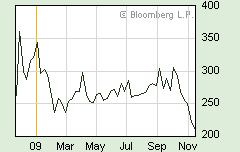 MBA Purchase Index hits a 12-year low.
 First the subprimes, now the option ARMs...

 ...where the green shoots are real.


 [Reuters]
 wheat futures heading up


 Not here. As far as savings go, Americans have gotten religion. We now owe less money collectively than we did a year ago, as the graph above shows. Not only do we want to get out from under; lending institutions are forcing us to submit to tighter discipline. They are making money less freely available now to protect themselves from risky borrowers.
 [THERE it is...]
 For the first time since World War II, the U.S. Gross Domestic Product has shrunk for four straight quarters (and five of the last six). Another post-WW2 first: we are completing a ten-year period with no net new jobs (see chart above). Wages and salaries, which drive recoveries in spending (not to mention tax collections), fell 4.7 percent in the 12 months through June, the biggest drop since records began in 1960. In other words, we have more dependents than ever before in a shrinking economy less able to support them.


 Source: Eichengreen and O'Rourke (2009) and IMF
 There will not be a bunch of new investment in industrial capacity until utilization gets back into the 80s. Meanwhile, employers appear loath to hire back laid-off workers. The average layoff has reached 24.5 weeks, a 60-year high:

 This is not your usual garden-variety recession. Because total debt in the U.S., public and private, exploded to four times GDP (a once-in-a-lifetime ratio) over the past twenty years, the unwind now underway will be protracted and brutal. As of the end of March, almost 8% of all single-family mortgages were classified as delinquent, up from 3.7% the year before and 1.6 % in March 2006. (Click on the graph above.) The problem? Too many houses--and not enough homeowner equity to justify all that construction.
 [below: updated for week ending June 26, 2009]

 (click for larger image)
 In the Emperor-has-no-clothes Department (and you thought E.D. stood for erectile dysfunction), financial analyst Meredith Whitney has been opening eyes ever since credit markets went limp in August 2007. Until then, big investment banks ruled. They were posting huge profits by peddling risky derivatives to greedy investors, as well as to unsuspecting state treasurers (that means you, Dave Lemoine) reaching for a few extra basis points of yield on cash reserves. But then skeptics like Madame Whitney began looking closely at (and behind) the banks' balance sheets and said "Hey, guess what, you guys are technically insolvent!" The CEOs at Citigroup and Merrill Lynch soon lost their jobs.
 You would think that an elected official, his last campaign behind him, would exhibit some independence and leadership. You would expect a willingness to confront tough issues head-on and to develop long-term solutions. No posturing, no sugar-coating. A termed-out executive has a rare opportunity to concentrate on the job at hand without the distraction of the next election--to do what is right, not just what is politically expedient.


